WRITINGS
A Dark Shamanic Practice for Dark Ecological Times.
This short five-part survey of contemporary shamanic art looks at interaction rituals, particularly in relation to the birds of the Ardennes, a third of which are currently threatened with extinction and the situation continues to deteriorate. I will explore whether contemporary art that emerges from a creative encounter across species boundaries can be labelled ‘shamanic’ in a European context and what purpose it can fulfil.
Part One.
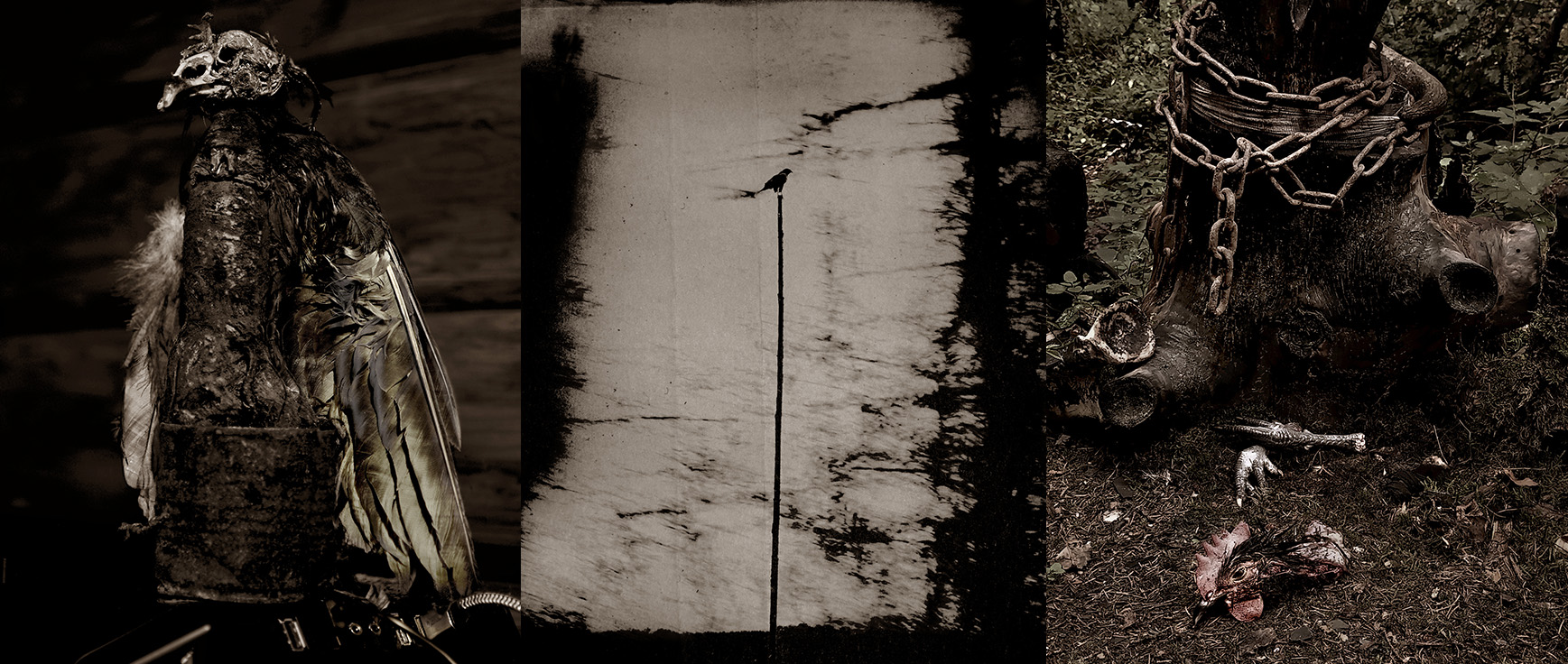
The production of an artefact like the one shown here takes a considerable amount of time and involves several steps. The first involved closely observing the scavengers as they ate the head and paws of a chicken that had just been slaughtered by friends on a neighbouring farm. This process was essential for establishing a deep connection with the base matter underlying the sculptural work.
After this outer and inner nigredo, I created something new by fusing the remains of the farm bird with those of a dead crow (i.e. a wild bird) and other materia magica. The resulting sculpture in some ways resembles what is called an ‘empowered cadaver’ in African Vodun, although I took it more literally than what is usually involved in the making of bocios, as Vodun sculptures are called. But I see this piece as primarily European, or even specific to the Ardennes, as it is linked to local economies and ecosystems and draws its strength from birds that have lived and died here.
Whatever the term ‘shamanism’ means exactly, now that it has moved away from its Siberian roots, if we want to apply it to our work, it must take into account our current living conditions. We do not live in an unspoilt wilderness, but in damaged ecosystems, and our so-called power animals are dependent on human regulation and threatened with extinction. I am sceptical that what has been damaged can be healed as long as the human population and its consumption continue to grow. And I shudder at the grim prediction that human activity may one day leave chickens the only birds on Earth. Still, I think shamanic art can play a role in our times by empowering the soul to transgress ecological grief and fear, and by building new connections between inner and outer nature.
Part Two.
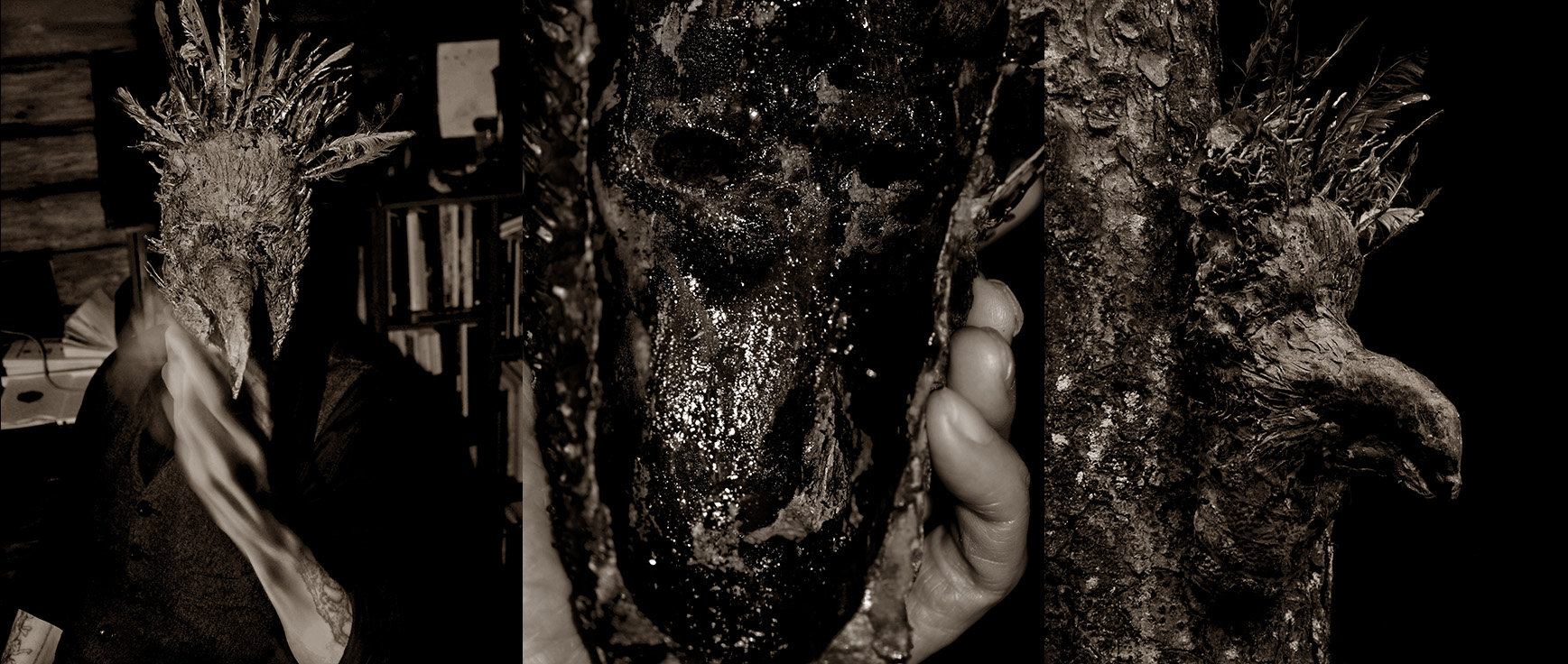
The ritual wearing of a mask is less about hiding one’s appearance or being seen as someone else, and more about seeing through the eyes of the other. This alone justifies a contemporary shamanic practice, as it journeys us out of the human perspective. In our everyday busyness, we forget that there are as many views of the world as there are species or even animal persons.
Wearing the mask overlays our human nature with our animal nature and merges the two into a unified consciousness. As a result, we see the surroundings with different eyes, in my case the Ardennes forest and its edges, which provide ideal hunting grounds for the resident birds of prey. From such an ecstatic superimposition of realities arises the possibility of developing a lasting sense of intimacy, both with the animals that live with us and with our own animal-ness, which allows us to enter into a kinship with them, as tribal cultures do by making animals, often birds, their totem.
To animate a mask, it is useful to smear its inside with animal and human blood. This facilitates both the mutual attraction and the lighting of the inner fire that we need for the ritual work. It is a perilous affair* for more than one reason and requires an art that has little in common with what we normally associate with the art we see in museums and galleries. Most of the art exhibited there leaves us stuck on its aesthetic surface. Shamanic art is not what we understand by ‘fine art’. Its purpose is not to please the eye through masterful drawing techniques or the ability to create exquisite objects. Rather, it draws its power from the formative and destructive processes of nature, channelling them so that they invade images and sculptures and then, through their contemplation and handling, enter the mind, where they effect change.
* Coincidence or not, many years ago a fire broke out one night after some ritual work with a mask and I woke up the next morning in a toxic cloud that left me coughing up black phlegm for days. I’ve been careful ever since.
Part Three.
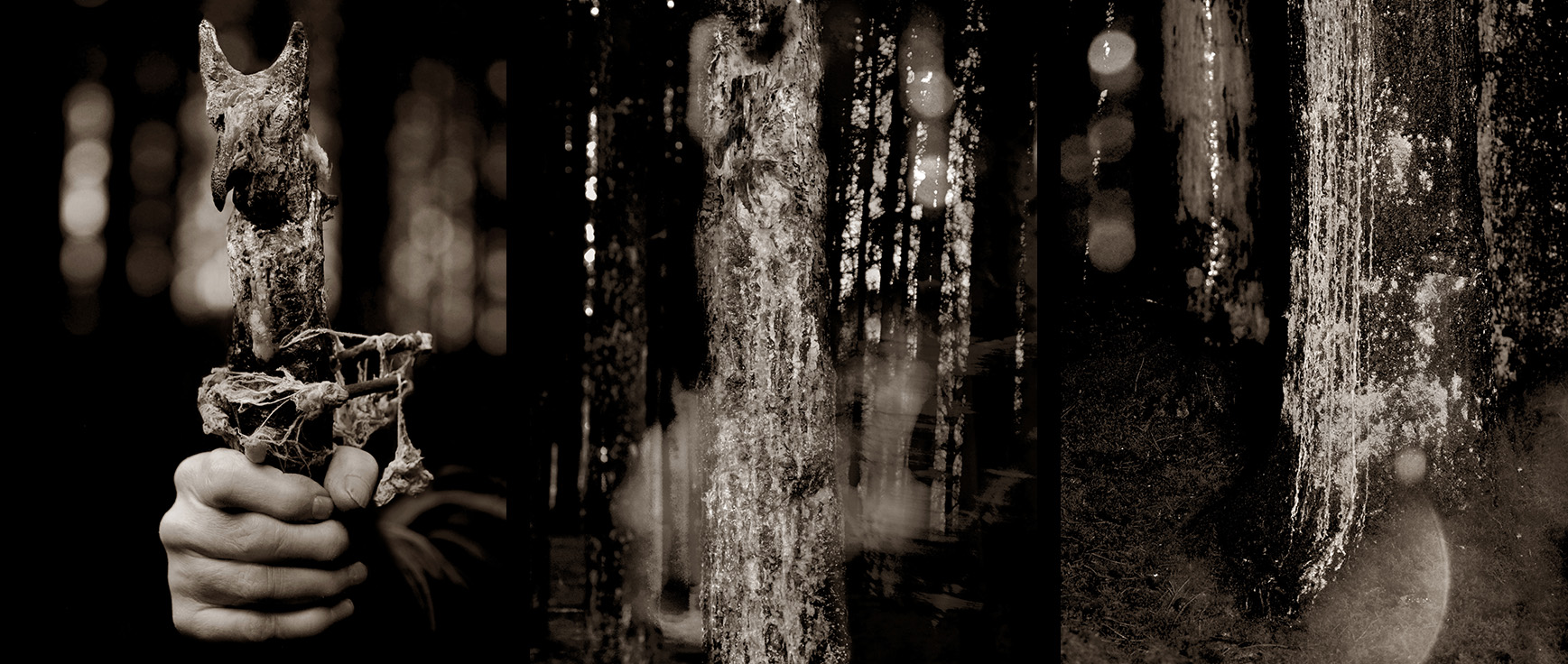
The ritual tool shown here, which I carved and then painted with buzzard excrement, initiated the flight to the nadir of the year. Spiderwebs hang from it to bind the demonic forces that accompany the journey into the underworld, both that of the forest and our own, to retrieve our animal soul trapped deep within. The confrontation with our own animality is characterised by ambivalence, because we only possess it if it also possesses us. Nevertheless, it is essential if we want to lead an authentic occult life.
Since Darwin’s study of human evolution, we know that we have been animals much longer than humans. However, we cannot commune with our animal ancestors, who are still buried in our bodies, through scientific means. Rather, this requires what Eliade called ‘archaic techniques of ecstasy’. And this is where the manipulation of sacred objects comes into play, as they enable the exchange of power and the transfer of transformative energy between our human and animal natures. In such borderline experiences, the mind shifts from a verbal to a visual level, so that we think with images, which is essential both for making sense of the visions we encounter on our infernal journeys and for creating this kind of art.
The key to visual thinking lies in association, juxtaposition and superposition. Shamanic thinking is characterised by the fact that the more similar things are, the more interchangeable they are. And if we can put them in a state of excitement and make them resonate with each other, we can transform one into the other. Shamanic kinship is not defined by the biochemical compositions that science uses to categorise the natural world, but by mutual attraction.
Engaging with our nonhuman otherness in an embodied sense and opening our bodies, or rather being opened by the other, results in the loss of our stable identity. However, this process allows for intimate relationships. Making shamanic art is like making love: it touches the deepest part of us, expands our sense of self and enables the transmission of emotions between those who participate in it.
Part Four.
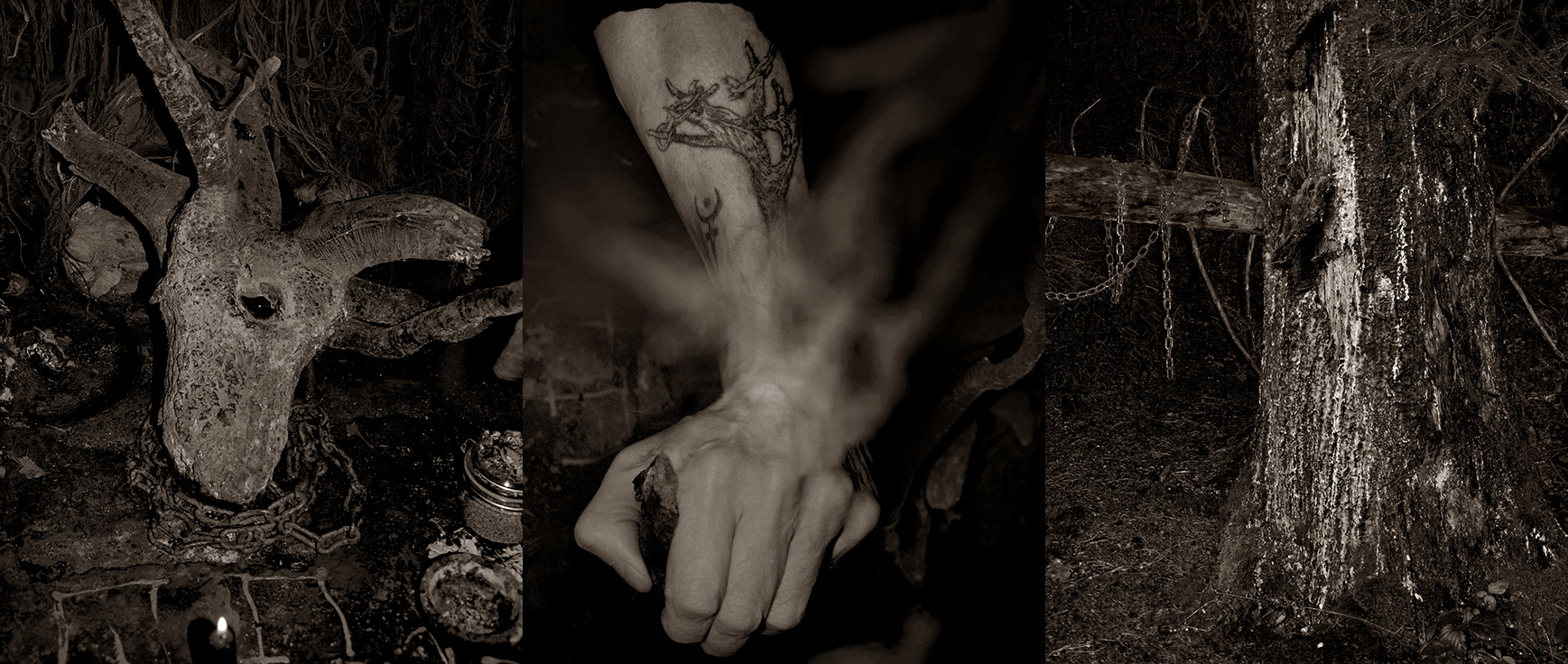
Totemic wooden objects retain a connection to the forest from which they come. They carry the memory of the mother trees that pass on their heritage, of the drought of exceptionally warm summers that threatened their survival, of the sap that flows to the roots in autumn, of their interaction with the mycelium, of the soil that holds the trees in place, of the minerals that nourish the soil. They also carry the geological memory of the ground and the catastrophic events that have shaped and traumatised it, the stored experiences of the microbial, plant and animal life that has walked on that ground, the birds that perched on their branches, the air that has carried them and the storm that has raged through the canopy. All this makes up the forestial memory and that of the sculptures created from it.
Sometimes I work the wood more or less. In the case of the piece shown here, which occupies a central place in my shrine, it has hardly been worked at all. I think the less a totem deviates from its original appearance as a tree, the more it acts as its mediator. And of course I don’t seal a wooden sculpture so as not to silence its oracular voice.
Perhaps the daily communication and touching of the shrine, which carries the essence of forest, contributes to what Lévy-Bruhl called ‘participation mystique’. The intense relationship with a sacred object that allows it to be experienced as a complex form of life in itself. I could warm-up to that idea if we could free it from its paternalistic view of the ‘primitive psyche’. But we would probably be better off focussing on what lies ahead.
What matters today is the development of a way of thinking and feeling in which human subjectivity is a part, but not the dominant principle. My ritual work is in many ways about breaking chains, those of Anarch*, entrapped beneath the world system, but also the ideological chains that keep us trapped in the belief that human nature is separate from nature as such. Ultimately, it is about revealing our most authentic inner being and creating new forms of solidarity and a shared politics of the earth.
*As readers of my book of the same name, published by Scarlet Imprint, will know, working with Anarch is a central concern of mine. Not only, but also because of the paradox that Milton introduced into the term in ‘Paradise Lost’ when he combined ‘monarch’ with ‘anarchy’. He was expressing the fusion of the natural kingdom with its underlying principle of chaos. Nature is anarchic and yet organised. But it is a horizontal organisation in which no power is exercised from above. The artworks shown here feed on the primordial dark sacredness of matter, the pagan graininess embodied in mythological tales as the ancient gods who were defeated and banished to the underworld by monotheistic religions and later by modernity. They must endure chained there until the fabric of the world realigns in such a way that they can be freed by the sorcerous intervention of their accomplices on earth and regain their original power over world events. In such a revolutionary narrative, the activities of sorcerers and shamanic practitioners overlap, which is rare, as the shaman is usually seen as the sorcerer’s opponent in traditional animistic societies. In this case, however, they are not working against each other, as both practices aim to rid the world of its current ills.
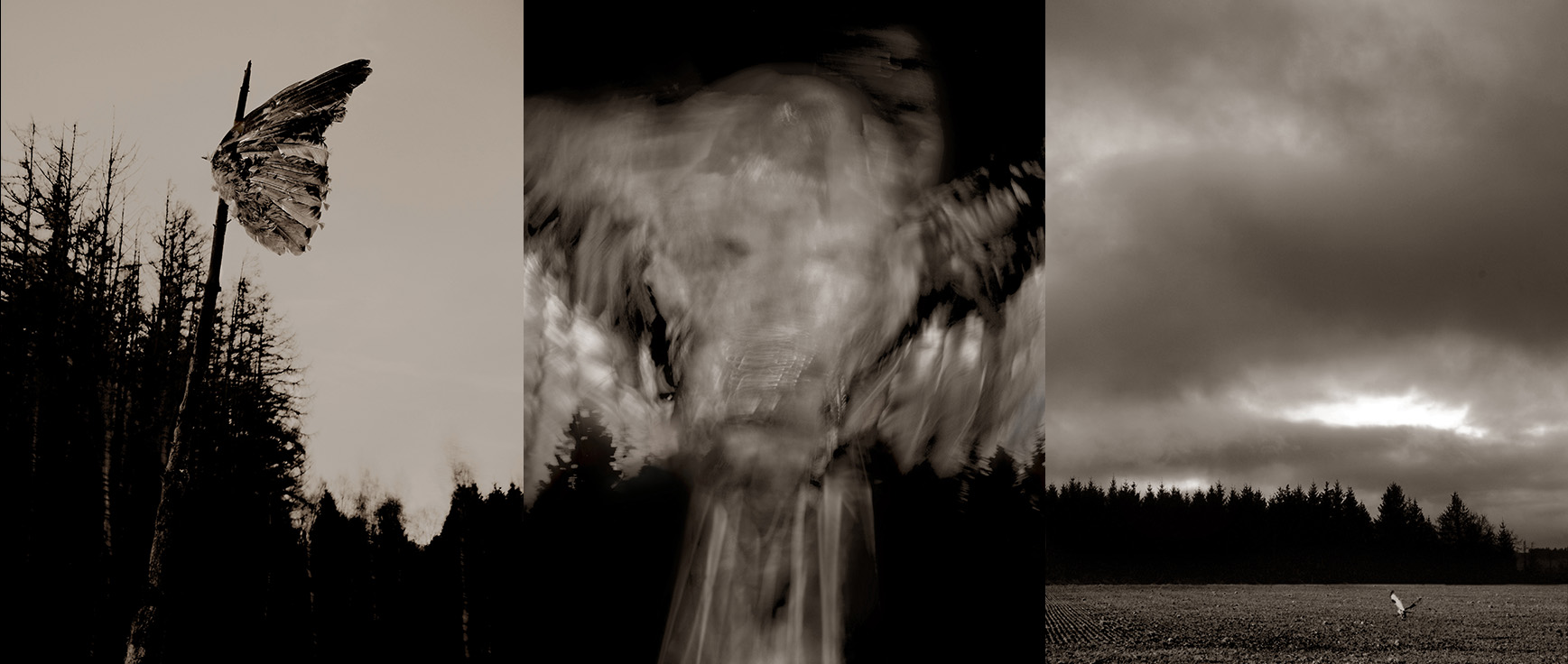
Part Five.
Contemporary shamanic art enables liminal experiences in the undead landscapes of what has recently been called the anthropo-obscene. We should not be afraid to call this black shamanism, for it expresses the poisoning of the planet and the extinction of a multitude of species, perhaps including our own. Our shamanic task is to merge the horror with the wonder, and to transmute the
poison into an elixir that leads us to radically reinvent our selves and our role on earth.
I don’t presume to prescribe any particular way of doing this, but I also don’t want to hide what I think is desirable. Take it for what it is: an experience-driven approach to dealing with the mess we’ve gotten ourselves into. I am not saying that what I am proposing will save us, but it will prevent us from drowning in the shame of giving up without trying to embody change.
Let’s build the dream of an interspecies community based on ecological equality. Let’s challenge the rules that maintain hierarchies, even between species. Such work will make us outsiders, but shamanic practitioners have always impacted their cultures from the margins. The question is whether our culture recognises the need for visionary practices that inspire bold political action. And whether we will be able to draw strength and ancient resilience from adversity. If we want art to be part of the solution and not part of the problem, we need to free it from its entanglement with capital and build our own cultural ecosystem based on a passionate engagement with nature, no matter how damaged or hostile it is or will become.
Let’s fight the cancer of the human soul with assault sorcery. Let’s practice mystical anarchism, a mysticism without a divine ruler. Let’s journey into realms where we experience our innermost self as that which is primal and darkly sacred. From such a deep connection, a new identity will emerge that is no longer just that of homo sapiens, but embodies multiple natures simultaneously. Well then, soul, take flight with the birds and heal. Who would have thought that my black shamanic story would become a healing story after all?
Gast Bouschet, 14th January 2025.
A Dragon’s Eye View.
When I showed my video installation Unground in Taiwan in 2014, the curator I worked with on site pointed out to me that the way I approach philosophical chaos has a lot to do with the Dao and the way Taoism is practised in Taiwan, where it is perhaps more closely connected to folk traditions and indigenous shamanism than anywhere else. In this culture, images play an essential role. They enable Taoist masters to gain access to the universe and use its powers to fight demons that threaten to take over the mind and body. Since they assume that everything is in flux, their approach to images is serial and processual, and the individual image is seen as a particle in a totality that can be grasped through contemplative and meditative practices. My art is indeed related to such an approach, but let’s move on to the philosophical chaos.
Taoist alchemy turns the world upside down and reverses the natural course of life. It takes the practitioner back to the unfathomable darkness that preceded the creation of what we understand as the cosmos. Or, to put it scientifically, what was before the Big Bang. This path back to the original source is populated by a variety of chaos beings. This has little in common with minimalism as we know it, for example, from Japanese Zen Buddhism. The original darkness that constitutes the void is understood in these practices as fullness rather than emptiness. Ten thousand things fold into each other. Again, I see parallels with my art. Basically, it is about seeing oneself from the perspective of radical otherness, liberating the self from the merely human and gaining a «Dragon’s Eye View », as it is called in Taoism. It is a practice that expresses this view in cryptic images and words. In alchemical art, it is never enough to name things; it is always primarily a matter of showing. And, alchemical imagery is always encrypted.
It is difficult for the Western mind to process demonic images without slipping into impotent fantasies. They are ubiquitous in popular culture, and countless films and TV shows feature digital monsters that will soon be indistinguishable from organic beings due to the rapid development of artificial intelligence. What we have lost, however, is the ability to appropriate the raw primal power that underlies these representations, to ally ourselves with it or to exorcise it. The forces of chaos have not been finally defeated in so-called Chaoskampf, but are still present in the universe and affect the world and thus us. They do this on both a large and quantum-small scale. The purpose of the sorcerous and alchemical arts, as I practice them, is to tap into this current of power, to identify with it and to channel it to bring about change.
Whether Chaos is formless or whether a dragon mother or demons live there is a subject of debate in the magical and religious communities that deal with such questions. Although from a mystical point of view there is much to be said for regarding it as emptiness, there are indeed many examples of some form of demonic presence being found in the pre-cosmic realm. Even in Taoism, which is careful not to define the origin and guiding principle of existence, exorcists resort to ritual meditation to identify with the pre-cosmic state in which they confront the demons believed to rise from the primordial source. Be that as it may, in a time marked by political and religious disillusionment and a general sense of endings, we would do well to take mythmaking seriously and look for ways to deal with decay and dissolution, whether they are personal in nature or affect us all.
The alchemists of old understood their work as the restoration of the universe as a whole. If we do not dismiss this vision as pompous or downright crazy, but allow it to penetrate deeply and work there, we come closer to what is meant by “our gold,” which for the alchemical masters was never the ordinary gold that the greedy chase after, but the inner gold that fills them to the core. One should not underestimate the wild nature of this occulted gold. It will forever remain in a fluid state, transforming, changing, slithering like a snake. It is the raw chaos, the inner beast, on which the alchemical sorcerers ride to bring about the reverse transmutation. Their goal is to become part of that which lives naturally and out of itself. In doing so, they cease to be merely human and become part of the demonic multiplicity that is the alchemical dragon.
In my meditations I envision the universe as this great beast made up of an infinite number of parts that are constantly destroying themselves and being reborn out of themselves. There is no beginning and no end. From the heat death towards which the universe is heading and which science predicts us, at some point something will emerge again, only to die and be reborn again, again and again. From such a vision I draw the strength necessary to create countercultural art and develop guerrilla tactics to resist and counteract the forces at work in the art world and beyond. Furthermore, it allows me to darkly re-enchant my world and not fall into nihilism and apathy in the face of unpromising personal and planetary futures. Ultimately, however, it is about creating a myth that I can participate in at the moment of death and harness the power of the universe with which I identify to live on as a nonhuman being. We need the alchemical art because we have forgotten how to die in the West after the death of God that Nietzsche diagnosed. The alchemical art teaches us how to die in a meaningful way.
Gast Bouschet, 20 October 2023.
Forest, Forest, Forest (until my blood contains all).
The first day of the year is called: The Word. On this day, which is not a word but a scream, the human lie is born. The following notes bear witness to this trick.
•
I recognise your smell. It rises from the forest floor like the scent of damp leaves and fungal decay. I open my mouth.
•
Every inhale a promise, every exhale a sigh over a missed opportunity.
•
Eight forty-five. A breath of truth passes by my window. Against the dark background of the trees, I see how quickly it escapes my gaze. I give myself over to my writing again.
•
Deceived by the lure of beginnings, a fox dies on its way into the dawn.
•
The bloodstain spreads on the snow, the painting begins to paint.
•
As the broth continues to boil, it thickens until eventually only a viscous residue remains, from which a moaning sound escapes. Something always escapes.
•
I plant the seed in the wound you have torn in my spine. Not for the sake of the tree that grows from it, but for the shadow it casts on my heart.
•
Your branches intertwine in my ribs, my love. Their cracking sound reminds me how much has yet to break.
•
The winter sun is so low that it blinds me when I look over at you. But behind my closed eyelids I see the dark blush you promised me.
•
A dream: I am wearing a mask frozen to my face. No one around me seems to notice. I am surprised by the stiffness of the chin piece and wonder if it will adapt to my natural movements or if it will remain as rigid as it is now. To avoid attracting attention, I act as if it were a human face, but it is not.
•
It’s finally morning. Minus 12 degrees. It’s a good thing I dug the hole earlier, the ground is frozen hard. I pour the boiling water into the pipe. Today I will break your ossified crust. Today I will melt your ice. But one bottle is enough.
•
Great art leads us to the edge of failure. Sorcerous art takes us beyond it.
•
In sorcerous art there is no place for an outside observer. You can only experience it by being destroyed by it. If that’s too much for you, you should go to the Centre for Contemporary Art. With the project-based art on display there, you can take a break from the gravitas of life.
•
Sorcery deals with the forces that bring disease and death into the world. However, this should not lead us to believe that sorcery is evil.
•
Perhaps demons are best thought of as mad particles.
•
If there is such a thing as a human soul, it is the part of us that is not human.
•
Written a hundred times on the blackboard:
There is no shame in turning my back on humanity.
There is no shame in turning my back on humanity.
There is no shame in … Nah, it doesn’t work!
•
It is Friday evening. The frosty ground shines like broken glass as I walk down the forest path to the shed. Tonight I will eat up the stars that lie at my feet.
•
Rise, black heat, rise. Rise through the wood and taste the blood.
•
First Sunday after Carnival. Will they resist the ordeal or do they love the flames so much that they willingly feed them?
•
Behold, the ashes cast off their veil of mourning and reveal their true power.
•
I don’t know if one can literally speak of rebirth, but in any case death multiplies the possibilities.
•
The Ardennes have been associated with the devil for almost a thousand years, as shown by the names of numerous rocks, gorges and natural sites that have preserved the memory of prehistoric cults. Places with names referring to the devil exist all over the world, but I dare say that their large number in our region, together with the excavated Celtic graves associated with human sacrifice, the infamous dark forests (the Celtic Ar’Den means “the dark”) and the many horrific myths and legends, that fire the collective imagination, as well as the very real witch hunts that took place here in the years 1550–1650, and the two world wars that were fought in the Ardennes in a particularly bloody way, make this region a place of sinister genius loci. So when you magically engage with this land, you better prepare for unsettling encounters.
•
La limite pluie-neige. Rain and snow have been raging through the forest for almost three hours now. Who are you to make it rain and snow so relentlessly? And, are you alone or are there two of you fighting for dominance?
•
What interests me most about digital photography in the context of this book is that it fuses the material and the immaterial into an uncanny mix. Something emerges from this confusion that seems radically new to me. I’m aware that the idea of the new in art is viewed with scepticism or even derision these days, especially if you’re not into AI aesthetics and conceptual-technological approach es. But it is this urge for the unprecedented that drives me, even if my old-school looking images do not suggest it.
•
I don’t particularly like the French language, even after living for more than 40 years in a country where it is spoken, but an expression like “entre chien et loup”, which means “between dog and wolf” and describes twilight, has it all.
•
It’s Tuesday, another dead fox in the hills. Long black threads emanate from the place on the head where the eyes were. I stare into the empty dark ness for a long time. Is there a tradition of divination from eye sockets?
•
According to Belgian law, my right to live in a forested area expires after two hundred years. Then the land is returned to the woods. When the may or told me this, I decided to become the forest so that no one can take it away from me.
•
Until the earth burns. Until everything melts away.
•
Art opposes culture. Art is basically a natural and therefore anarchic phenomenon, not a civilising one.
•
The stone of the wise does not conceal itself in collaborative network structures.
•
Tick infestations, bark beetle larvae and toxins trapped in geological strata, among other things.
•
The subjects vary, but the act of painting itself is always an attempt for me to give materiality to what lurks at the edge of understanding. However, if I succeed in giving it form and texture, which is far from always the case, I open the floodgates to inundate it with obfuscating liquids and substances.
•
Imagination can only take us to a certain point. Behind it lies the terrible truth of the universe.
•
The question is how to use sorcery as a political tool in a time of irreversible planetary change. An important step in that direction would be to advance a sinister animism that focuses on materiality rather than the obsessive search for happiness that dominates modern society. Unlike what is commonly called magic in esoteric circles, which is primarily characterised by a desire for person al well-being, sorcery is painful and acts like a curse against the rising tide. Dubious as it may sound, we need shunned, offensive practices to meet the challenges of upheaval.
•
23:25. It’s getting late. I let the painting dry in the belief that it has found peace. It has already been through enough today.
•
06:35. The ceasefire of the night is followed by a merciless dawn that reignites the war between form and materiality.
•
A successful painting shows that the hostility remains, even after it has come to rest.
•
Winter has come to an end, but its dogs still gnaw at my backbone.
•
After the blood has touched the ground, a shower of rain pelts down on the shed. This is soon followed by another noise, this time sounding more like an avalanche of small falling stones. Once upon a time, during a lunar eclipse, blood rained down on the earth and froze into a mountain that was once higher than today’s Alps. The shadows still cast by the old, dying mountain and the stones that some times erupt from it guide the work.
•
Sometimes its original barbaric power can still be felt, but today Arduinna draws its black magic mainly from extreme weather events and tree pests that spread due to drought. The increasingly prolonged dry spells are occasionally interrupted by torrential rains. In 2021, we were hit by terrible floods that turned into the deadliest natural disaster in the country’s history.
•
Halfway back from the shed I hear the cry of a buzzard. The shadow it casts on me curses me with the sign of the cross. It is now early evening and my legs ache even more than usual at this time of day as I paint the Angel of the Forest hovering over a flooded landscape. Is my pain transferring the curse to the painting, or is it all in my head?
•
The only paintings that work sorcery are impetuous and flawed. Tasteful, skilfully crafted images are useless when it comes to intervening in the depths of personal and planetary consciousness. The coffee has gone cold. I take a lot of time this morning to observe the drying phases in which the dragon’s blood turns from a bright red to a darker crimson and finally to dead black, much like digested blood.
•
Working with dragons means making darkness and flame yours. It means working with the inescapable instead of wishing it away.
•
Oh dear God of contemporary art! Forgive me for corrupting my conceptual ambitions with visions of satanic rapture.
•
08:15. Thursday morning: Carving a pain catcher out of the potato I’ve been carrying around in my pock et for weeks. I blow on it to animate it, and the warm air from my lungs intensifies the sweet smell it still gives off after being peeled. A memory of my father’s bakery flashes briefly. Too briefly to bring tears to my eyes.
•
When the potato shrinks as it dries, the pain should decrease. It does not.
•
Yours is my blood. Yours is my suffering. All that I am, I give to you. If you want it. Do you?
•
What? What is this fucking bird saying?
•
I cut off the raven’s head and throw it into the fire. Thick smoke rises into the air and a horde of metallic shimmering flies appears out of the blue.
•
On my good days, I don’t want to leave the forest at all. On my bad days, I know that I will never leave it again.
•
Today at 03:30 there is a lunar eclipse. I watch the earth’s shadow move across the moon’s surface and then place the bowl on the tree stump in the clearing to catch the moon snot as it falls to earth. After drinking it, I move effortlessly and invisibly through the night air.
•
The cut is deeper than it should have been and the dripping blood forms a small puddle on the forest floor where red wood ants scurry around their mound. In moments like these, I think of myself primarily as food.
•
I’ve been hearing noises in the walls for days. It’s probably mice again, but this afternoon a grass snake ran into me. Had it entered the shed in search of rodents? Was it looking for shelter from the heat?
•
Sunday, shortly after 6 p.m. The sky explodes with divine wrath. The forest floor ruefully swallows the rain that finally falls.
•
Urge, hunger and thirst everywhere, and salvation dries up on the greedy ground.
•
Noon on a sunny Wednesday: I pull the loose bark off the spruce to take a close look at the winding tunnels of the beetle larvae. Their shapes form letters and I can decipher names, but ours is not among them.
•
The book becomes more and more an elegy to the dying spruce forest. Spruce covers almost half of the forest area in the Ardennes, and it is in a miserable state. It is not a native species, but was introduced in the 19th century to rapidly reforest the area after the metal industry had cleared the woods for the production of charcoal. Because it grows fast and straight, the spruce is an economically valuable tree, but it has vampiric traits. It dries out the soil and is very susceptible to pests due to its monocultural planting. In our small woodland we had to fell over a hundred trees because of bark beetle infestation. It is a real plague and the skeletons of the dead spruces play a significant role in shaping the landscape of the Ardennes today. In connection with my images, it is interesting to mention that in Russian folk tales its roots are associated with bird feet (the hut of the old witch Baba Yaga stands in a dark forest on chicken legs, whose claws resemble spruce roots in many illustrations). I suspect that this is at least partly due to the fact that the root system of the spruce is shallow and develops laterally. You don’t hear the laments of the forest, you smell them, especially in the unnaturally hot summers of recent years when the temperature finally drops as night falls. These nights open up the possibility of interweaving one’s own dreams with those of the forest.
•
Midnight in late June. A glow worm escapes into the ether with a flash of fire.
•
In many of my dreams, the landscape in which I move is shrouded in darkness at some point. It is as if a great veil suddenly covers the world. This happens again and again, no matter what my dream is about. I have become so accustomed to this process that I find the resulting blackness in which I then continue to dream familiar and somehow comforting.
•
Since his early death, my father has played an important role in countless of my dreams. Unjustly, he often appeared in them as an unreliable character who left my mother for no reason, or as an indifferent alcoholic or heroin addict, all things that had absolutely nothing to do with the reliable and caring character with which he was endowed with. But probably the most painful dream I had about him is the one in which I tried to summon him back to life. The memory of the dream begins the moment I see my father in a zombie-like stupor, surrounded by some of my ritual tools. I rub his face with fresh plant sap and implore him to wake up, but despite my persistent efforts, I fail to bring him fully to life. He stares silently into my eyes for what feels like an eternity and it breaks my heart to see him in this state. Even during the dream I am aware that I have broken a taboo. I am deeply ashamed and would do anything to let him rest in peace again.
•
The treacherous stars draw their circles high above the valley. Below, the faithful follow their movements as if they were participating in a communal choreography. But one of them breaks out and lifts the cosmic curse.
•
Horned shadows move through the forest, holding their breath briefly at midday. The sun longs to scorch them, but they are restless and move on, branching out further into my chest.
•
I want to see what you look like under your bloodstained robe. Will you allow me to do that? Will you allow me to see you undress before you bathe in the pond?
•
Remind me to blacken my eye sockets with bone char coal before I look at you. Will you do that?
•
Deep, deeper still, deeper than any depth, I fall before I glimpse the shadows moving at the bottom of the well. Deeper I can fall no more. Or can I?
•
The gates of the earth are open. Do you see them? The writhing cables, the corrosive waters, the eternal fire. Down here, everything is exactly as it should be.
•
The oracle does not utter a word, but its prophecy unfolds nonetheless.
•
Worms, not words, reveal the truth of the earth. To them I must rewind to fit through the gate that leads to your inner organs.
•
And then there are the ribbons of flesh dangling from your ribs, the venomous toads and the snakes that eat them, and the worms that pair with the roots of the trees.
•
Sometimes I dread the thought of diving this deep into the work, but most of the time I would love to disappear into it.
•
What do you want? Attention. What do you need? Love and golden nectar. What do you get?Indifference. I watch the demon absorb what the universe has to give.
•
The opposition for Saturn is at 5pm today. Yes, the point is to get out, but these days the only way out for me is in (i.e. a distant place within).
•
Since I cannot share in your splendour, I will cover my head in ashes, so that at least in your downfall I may be like you.
•
Ingredients that enhance the painting’s demonic qualities: the reddish rust of iron, a few drops of black bile and mould soaked in the hope of renewal.
•
Another misshapen figure carved from an old potato. Uncomfortable thoughts about ageing, dryness and withering. Where does the old, crippled witch hide now that her young, sexy version has become a feminist icon? Do I see her crouching there in the undergrowth?
•
Tonight I finally resume negotiations with the vampiric insider. The fact that it feeds on my life force does not preclude the possibility of collusion. Even if this unholy pact will always remain precarious due to the unpredictability of the agent I am dealing with.
•
It is the interaction between surface & subsurface that turns painting into a necromantic practice.
•
Sometimes the subject insists too much on its sovereignty, but I don’t want to reduce painting to an abstract play of form and colour. The predatory nature of abstraction only thrives beneath the surface and must not be dragged out into the open where it degenerates into a style. Abstraction is only dangerous as long as it escapes the gaze of the sun.
•
What is depicted may seem repulsive, but the abstraction that underlies it is what makes it truly abysmal.
•
I have used spider silk in combination with hair to make sticky demon traps, but perhaps the greatest magic potential emanating from spiders is manifested in cosmic cannibalism. A few days ago I read that a huge black hole had been discovered in the middle of a “cosmic spider web”, as the article put it. I am not surprised that black holes are the result of spider work.
•
New painting in which the perforated tissues and viscera become the cauldron. The alchemical vessel does not enclose the injured organs, but consists of them.
•
Drew cosmic cannibalistic spells and put them together with lard in a cloth figure and tied it to the big birch tree behind the house. At first nothing happens, but after a few days an animal tears the thing to pieces and eats the fat together with the spells.
•
Your fiery mass of hair flares on the western horizon as I wrap myself around your roots on our way down to the centre where gravity reverses.
•
The roots hold the secret.
•
I know you’ve been on my tail for a while. You’ve internalised your shadow so I can’t see it on the forest floor when you stalk me from behind, but I can feel your breath on my neck. It won’t be long now before your hungry fangs sink in.
•
On the last day of October I finish an almost monochrome painting. Working on it screwed up my back even more than it already is. I had to interrupt the process several times and take long breaks be fore I could continue. But now I have reached the dense, nourishing blackness from which the larvae of the dead will hatch. I make it into the forest just in time to sink the painting into the crevice at sunset.
•
It is the first of November. I spend the late afternoon looking through old family albums and thinking about a letter my father wrote to my mother when he was stationed in Russia. It touches me that he only gently hints that he misses her. What loving and respectful restraint in his words, which were certainly also shaped by the feeling that neither of them knew at the time what the future held for them.
•
As darkness falls, now early after the clocks have changed to winter time. I mix the last of the cognac I have left from my father’s stash with some of my blood before focusing on the spell, which is guided by the desire to preserve my ability to endure pain in the coming year (I have refused to take opioids since my accident, and I want to stick with that decision for as long as I can). I won’t describe the exact process here, just indicate that I leave my offerings to the animals of the night. On the way back to the house, a toad crosses my path.
•
The second of November. I leave the door of the shed open to breathe in the night air. Tonight, no candlelight will desecrate the blackness. Before my meditation session, I dip my finger into the bone charcoal and mark my forehead with it. The deep breathing exercises make me slightly delirious and the inside of my body has filled with black air, but the night is still split in two. I will destroy the skin so that inner and outer blackness merge, but not yet.
•
Still marked on my front from last night. The dead have retreated back into the earth to dream their stony dreams.
•
The mice drank the booze and blood, threw it up back into the offering bowl and later ate the vomit.
•
Made three new cloth dolls. One is filled with powdered charcoal from the cellar of the house where I grew up. Another with dried poisonous plants and stinging insects that I collected during the summer months. And a third, the bottom of which is covered with bone ash, the middle part with soil and root tips and the top mainly with crushed toadstools, which grew in abundance this year under the spruce and birch trees next to the house.
•
The outer material of the dolls is linen, which came from my late family’s household, and some of the figures they represent certainly reflect traumas that have burdened the family, such as my grandfather hanging himself in the cellar. But I often have fond memories of the material I use. Many of my drawings are made on notepads that come from my parents’ bakery shop, where I played and drew on the floor as a small child. The house we lived in was built by my great-grandfather in the late nineteenth century, and neither my parents nor my grandparents threw away anything that could be kept. When you were in danger of losing everything in the war and lived in a house disfigured by shell fragments (the back façade was only renovated when I had to sell the house after my mother died in 2017), you had a different relationship to things than most people in Western Europe today.
•
You cannot do sorcerous work in the Ardennes and leave out what has gone down in the history books as the Battle of the Bulge. The ground is soaked in the memory of what happened here during the Second World War. Also, the ghostly presence of my father hovers over many of my ritual works. I would like to take this opportunity to dedicate a short tribute to him. When Nazi Germany invaded Luxembourg, he was forcibly recruited and sent first to Poland and then to Russia, where he froze his legs to death in winter. His friend was able to prevent them from being amputated at the last moment by lying to the surgeon that he had seen my father twitching his legs. He recovered and was sent to Italy, where he worked as a messenger and was informed about the Allied troops moving up from Sicily. He then decided to hide in a vineyard and defect to the Allied troops, who sent him to Morocco to a prisoner of war camp and later to Edinburgh, where he was held in the castle I later visited. When he was finally cleared of suspicion of being in league with the enemy, he joined the Piron Brigade, which crossed the English Channel alongside British troops and set off north from Normandy to defeat Hitler’s army. In September 1944, they reached Brussels, where they were celebrated as liberators. At that time, none of them knew that the terrible winter of the Ardennes Offensive still lay ahead of them. I have left out much here, but perhaps this little story will stimulate reflection on how personal trajectories and choices can play a small part in shaping world history.
•
The sacred goal is to create a work of art from the substance of blackness itself. I will fail, but sometimes, on particularly dark nights, the sculptures in the clearing seem to be of such density that their gravitational pull draws the eye down into the forest’s underworld. They then become gateways into eternal chaos or, to use Milton’s words, “shrines of Anarch old”.
•
It’s not me, but the sulphurous pigments and the mercurial solvents. Maybe there is hope for my painting after all.
•
In the morning I study the flight patterns of buzzards and crows over a patch of woodland where a deer has died. Later in the day, I draw lines on the last page of my grandfather’s battered Bible, which turn into disordered waves after crossing a blind spot. There is a kind of occult resonance at play here, but I cannot put into words what it consists of.
•
After you tell me that no one will know where we have gone, I step out into the night and see a comet with its tail pointing downwards.
•
Shortly before midnight. Time slows down in the rainy forest. The sodden flesh loosens from the
bones.
•
What is an end?
Gast Bouschet. Undated diary extracts.
Only chaos sings the truth.
We often have a hard time with what does not correspond to our values and norms, and usually cannot imagine that our world view is not shared by everyone. This is also the case in art. Contemporary art biennials like to emphasise in their press releases that their exhibitions draw from global diversity and transcend the boundaries of fixed rules and notions of what art is. More often than not, however, they do not engage with the uncomfortable Other that does not fit seamlessly into their strategies. Otherness is encouraged as long as it affirms trending cultural, i.e. Western, values, but it is evaded when it refers to something completely different. These processes of inclusion and exclusion are more or less subtle, but in any case, participating artists must not go against the grain if they want to establish themselves. Many of them will probably deliver what is expected, but I hope that this year’s Venice Biennale will at least feature some antinomian artists who create works that are not easy to digest. It is important to reclaim controversy and use artworks as powerful sorceries that interfere with the world in all its uncurated ambiguity. We should not bow to the conformism that hides behind the philanthropic pose of the art world, but defy it when we can and escape it when we must. But more on that later.
When I presented the video and sound installation Collision Zone with my partner Nadine Hilbert in the Luxembourg Pavilion at the 53rd Venice Biennale, many found the walk through the noisy black rooms unsettling, but few could or would name the confusion into which they were drawn. I described it as follows in 2009: “Our work reflects the dark side of European identity: its typical suspicious look at the intruders, the spectre of fear that haunts the mind of those who hold the treasure.” Collision Zone did not make it easy for Biennale visitors to position themselves in relation to it while being sure to be on the ethical side of things. This fundamental uncertainty was not lost on some critics and journalists. Jérôme Netgen, for example, wrote that Collision Zone was permeated by such underlying violence that one can only stand speechless before it. And Kunstforum International said that it did not allow an escape into consternation, but left an oppressive feeling. They were not the only ones who felt this way, but most did not quite know what to make of it, or they simply couldn’t imagine Collision Zone standing outside the moralistic trends that were already beginning to dominate the art world at the time. This tendency has grown considerably since then.
In recent years I have become more of an escape artist than a participating member of an artistic community. Sometimes I still hex art institutions, and frankly I enjoy blacking out their white cubes and playing with them, but I no longer believe we can change the art system from within. Well, we probably never really could, but at least radical artists used to curse those who have the power to define value and taste. Nowadays I have the impression that even so-called art activists, as far as I can tell from a Western perspective, submit to social norms that condemn anything that offends polite society. But my critique of repressive decorum really only scratches the surface. Political correctness merely serves as an aesthetic correction that gives the monster a more humanitarian face, but leaves untouched the profound injustices that underlie the globalised art world. International exhibitions often try to give the impression that they are working for a fairer world. Behind the scenes, however, they become more and more entangled in the machinations of the states and corporations responsible for the injustices they publicly denounce. I am not the only one who notices this two-faced game, and I find it regrettable that so many intellectuals and artists act as if it is inevitable to play along. But ultimately each of us must draw our own conclusions. For my part, I can’t help feeling that my institutional critique is ultimately hypocritical unless I shift my main focus from the contemporary art world to something outside it.
You can call it withdrawal if you like, but since moving to a remote rural area, I’ve been questioning my place in the world more thoroughly than my previous existence as a vagabond artist allowed me to. Constantly hanging out in anonymous airport waiting rooms and hotel lobbies does not make us socially and ecologically engaged artists and curators. And the deep meaning of what we do is not revealed to us by the endless stringing together of exhibitions and opening ceremonies. I was on my way out long before that, but it was only after a spinal trauma that I really became aware of how disconnected these routines are from the often painful realities of life. Don’t get me wrong, I don’t want to glorify the consequences of this accident as some kind of positive awakening experience. They affect my life in many ways and the chronic pain is increasingly difficult to bear, but the spatial restriction caused by the trauma also holds an opportunity for me. It forces me to concentrate on the essentials and intensify a practice that I have often had to veil in my public appearances. This practice, which I call alchemical sorcery, places my art outside the institutional order and connects it to the anarchic energy that operates underground.
Sorcerous artworks derive their power essentially from the turmoil that underlies them, from the elemental agitation of the materials of which they are composed. But for their materiality to become contagious, it must interact with the energy that moves outside in the open. Only when the inner and the outer work together is art capable of effecting change in the world. So far in this essay I have mentioned my videos, but in the past few years I have aligned my art with ecological and biological systems. At first glance, the installation I have created in the Ardennes Forest seems frozen. It does not reveal itself to the casual observer, but when you explore it in the restless passage of the seasons, the ever-changing weather and light conditions, the entropic forces acting on it, the storms sweeping over it and the interventions of the many plants, animals and microbial communities involved in it, you realise that it is anything but lifeless.
If we are to devote ourselves to sorcerous alchemical art, our first task is to create the necessary conditions in which it can flourish. I will not presume to give guidelines on how anyone should do this, and we would also do well not to make our methods public in all their radicality. I can only give hints that point to the elaboration of an effective practice. My work alternates between brief moments of feverish heat and longer periods of patient composure. Both parts are important. My intensifying focus on patience is one of the reasons why I have lately been referring to my art as alchemical sorcery rather than sorcery tout court. Sorcery is too often associated only with violent emotional outbursts. In most cases, however, I achieve the best results when I act calmly and take my time to proceed. My experience has taught me that overly impulsive actions often ruin the work before it is completed. If we are patient, as the forest is patient, our art will grow and blossom into full strength.
For almost four years now, I have been living in the Ardennes, far away from the busyness of the art world. I spent most of the first year observing the forest, which showed me that in it life and death are part of the same dance. At the same time, I studied the forces hidden beneath the forest floor, such as the mycelium, which describes the symbiotic relationship between tree roots and fungi, but which will always remain something of a mystery. Only after thinking at length about the entangled life beneath my feet did I begin to dig up roots to carve and paint with bone charcoal, a substance that has served as alchemical fuel for centuries. To a lesser extent, I have also used iron oxide to create a sympathetic connection with the iron in the blood. Sometimes, however, I use my own blood directly to infuse my vitality into the work. Over time, I have arranged the objects into shrines and associated them with poisonous and medicinal plants, as well as decaying animal parts that I have found in the forest. It would have been illusory to think that these assemblages belonged to me alone and it was not long before the animals began to interfere with them, taking out what they could use for their burrows and nests and feeding on the organic remains. At times, I had the impression that they only destroyed the artworks to express their anger and exercise their power. But who am I to judge the motives of wild animals.
It requires a shift in thinking to acknowledge the otherness and particularity of the myriad beings that live in the forest and at the same time identify with their deeper essence. It is probably even more difficult to identify with the microbial galaxies that make up our bodies, but it is only through such associations that we gain access to the universal. We need to think in images rather than words to approach alchemical truths and I will not put my working methods in writing here. Suffice it to say that they aim to transform nature into a blood and dissolve my microbial selves in it. Alchemy kills the living and brings the dead back to life. How this is done is a mystery, but this much can be said: The blood that flows through our bodies carries the most basic and important elements of life and consists largely of water, salt and other ions that already made up the primordial sea. Blood essentially connects us to our dark, anarchic origins. The occult aim of alchemical sorcery is to make us participate in the unconditional freedom from which we once arose. The unprincipled blackness of the beginning is also the ultimate goal of the Great Work.
But let me return to a less speculative philosophical approach. The installation I am setting up here gradually turns into a mess. The damp forests of the Ardennes let algae and lichen grow on the wooden objects, fungi spread and moss overgrows large parts of them. This certainly doesn’t look attractive to everyone, and the rotting animal skulls and carcasses don’t exactly give it a more socially acceptable appearance either. The conditions under which art exists here are fundamentally different from the sterile environments of contemporary art museums and biennials. It also seems important to me to point out that I do not renovate the works, as happens in the so-called sculpture gardens or sculpture parks. I do continue to work on them after they have been exposed to weather, putrefaction, and animals, but not in the hope of restoring their original aesthetics, but to respond to the pollution that has altered them. My aim is to incorporate the corrosive materia vilis and make it viscerally present in the installation. “In Sterquiliniis Invenitur”, “in filth it will be found” is a central alchemical statement and I am convinced that the black sun shines strongest where impurity allows the least distance.
In order to transform my practice from a purely artistic to an alchemical one, I have to identify with the afflicted matter. Within it shines the luminous blackness that reveals to me that its underlying chaos is the crucial element of transmutation. I am not interested in showing the installation to an audience or preserving it for eternity, but in materialising its inner tensions and then releasing it into the freedom of unbound life. The work is currently in an intermediate stage. Some of the older pieces are already completely destroyed and overgrown, while the newer ones will remain standing for some time until they too are conquered by the forest. I hope to be able to work on it for a long time to come, but I have no illusions that the art will last. Its ultimate goal is its destruction and transformation into alchemical base matter.
Gast Bouschet, 20th of April 2022. Letter to sorcerers written on the occasion of the opening of the 59th Venice Biennale.
Anarch
Some basic reflections on the images included in this book.
Art is always autobiographical in one way or another. My subjective perspective has influenced all my work, from the intimate explorations of border zones in a security-obsessed world to the immersive video installations that juxtaposed postmodern urbanity with the forces of nature. Yet, never before has my work been so rooted in personal experience as in the following images, which I present under the title Anarch. It is impossible to talk about them without elaborating on how they came into being and what state I was in when I created them. What you will discover in this book is the result of a work that aims to connect with the forest of the Ardennes as a living theatre, a theatre of cruelty, to use Artaud’s words. To get straight to the point: for some time now, I have been working from the perspective of someone who lives with constant pain. I have to find ways to deal with it and my focus is not on optimistic healing practices. We have to come to terms with the fact that not everything can be fixed. This is true on both an individual and a universal level. Our cultural narratives fail us when they treat pain and suffering only as phases that must be overcome.
If I can transform immaterial pain experiences into powerful objects and images that help me mirror human and planetary woundings, then I will have achieved my goal. It is important for me to point out that personal distress does not preclude a magical approach to life. Quite the opposite. The magic I am thinking of uses the satanic intensity of pain to direct the will to align with the realities of nature. Practices that use vulnerability as a means to conjure strength from deeply uncomfortable and unwanted conditions are not exactly welcome these days. Contemporary society reduces pain to a medical problem, and our anthropocentric perspective prevents us from seeing that all beings suffer and struggle to survive in the world. To say that pain is natural and universal, or worse, to listen to it and participate in it creatively, is one of the last taboos in occidental culture. It may have to do with the fact that the pretensions of human exceptionalism can no longer be sustained when we recognise that all life forms are interconnected in this way.
My work has always revolved around two poles: to make visible the connections between human and non-human agencies, and to develop sorcerous strategies that offer a way out of institutional capture. By distancing myself from urban centres of control and renouncing the lure of public recognition I have acquired new and effective ways of living and acting in the world. This is what makes sorcery so relevant, it projects me into an anarchic beyond where nothing is fixed. However, we should be careful not to fall for illusions of redemption. Sorcery will not save us, but it allows us to take matters into our own hands. My practice does not aim for an ideal future, but for creative survival in a chaotic world full of unease. I want my art to be like life itself: imperfect, messy, dirty and full of ambiguities and underlying violence.
Just about everything I do today is site-specific and has the forest where I live as its centre. There is an old wooden shed here where I meditate every night and ritually engage with the surrounding woods. I have felt the black magic potential of this place since the first moment I saw it. A tree that fell during one of the many storms that have raged here in recent years is still leaning dangerously against the shack. Inside was an old power generator that the previous owner had placed there to keep it as far away from the house as possible because these machines were so damn noisy. Everything reeked of leaking fuel oil and the forest was littered with rusting industrial debris. I just loved this piece of wounded land from the beginning. Drawing strength from the contradiction of creation and destruction has always appealed to me and my appreciation for it goes way back. The landscapes of my youth were shaped by iron mining and industrial decline. Punk flyers and the posters of the Rote Armee Fraktion were among my earliest aesthetic influences. When I was in my late teens, I was torn between radical counter politics and the predatory animism of Castaneda’s early books. Quite a wild mixture really, but exciting youthful days for sure.
Over the last few years, I have transformed the shed into a sanctuary where I can become what I create and create what I have become. Some of the rites I perform there are inspired by the shamanic practice of transforming the suffering body into a sacrificial meal for demons, but most of the time I am engaged in activating the sculptural assemblages I build from materials I find in the forest. What goes on inside the figures is at least as important as their outward appearance. I work a lot with bark beetle larvae, which infest and kill spruce trees en masse in our region, and last year I filled soft sculptures with spruce pollen, which covered the ground with a yellow carpet for weeks. This is something that happens naturally every three or four years, but the trees also release it when they are exposed to drought stress or when they sense they are dying. There’s a name for it in German: Angstblüte, which translates as fear blossom. I also use digitalis, foxglove as it is called in English, along with soil from anthills and other substances that are better kept secret. Foxglove is very poisonous and can be fatal even in small quantities if ingested, but as always with pharmakonic plants, there is a strong dialectic involved. The sculptures draw their magical power from the organic materials that work inside them, but also from the natural forces that act on them from outside. Eventually they will release it back into the earth as they fall apart and decompose. Even after they have merged with the forest, the alchemical sorcery that animates these objects continues to play an active role in the cycle of decay and regeneration.
When you work in the forest all year round, you can’t help but sometimes be confronted with the violent destruction of life. This can either be due to natural causes or human transgressions. In our area, a lot revolves around hunting and we often hear gunshots, even at night. I found two wild boar carcasses that poachers had left in the forest to rot after cutting out what they thought was the best meat. For several days I saw buzzards feeding on them and I used their droppings to paint the white parts of some of my sculptures. The main goal was not to please the eye, of course, but to absorb the magical power. The waste product left over from the conversion of energy from one powerful organism to another seemed to me to be particularly suitable for conjuring up transmutations. There was a lot of activity in the forest before the wild animals carried the body parts away and after a week, almost all traces of the kill had disappeared. The whole thing left me with the uncanny feeling of having come dangerously close to the forces of death, but such encounters always alternate with the emergence of new life in nature. At some point, a comprehensive sense of transience crystallises from the sum of these experiences, which I try to condense into visual form.
Because of my infirmities, I can’t move far from the place where I live, and when you stay in one place for a long time, a strange symbiosis sets in. The forest is increasingly taking possession of me, in more ways than one. I keep dreaming about it and the animals that inhabit it. That’s why they play such a big role in the book. Wild animals are sacred! No matter what type or size they are, they give us a glimpse into the true nature and meaning of life. I observe the activity of buzzards and red kites almost every day, and often at night I see spiders weaving their threads in such a way that their webs become an integral part of the installation that stretches across the entire shed. I take as much time as possible to study the lives they lead here in the dark and meditate on the patience they have in what they do. It gives me comfort to see that not all creatures are as restless as us humans. I have always been fascinated by the relationship between spiders and the universe. I am thinking here of Bataille’s article on the formless, in which he compares the universe to a spider and spit, but also of the magical relationship of the spider to the moon and lunar dew. It is interesting to note that the spider, like the moon, is associated with madness in French culture. And in Victor Hugo’s writings there are allusions linking the spider to the black sun. Fascinating material to draw inspiration from.
The black sun is a symbol of initiation that runs like a thread through the book. It gives form to that which defies understanding and can be related to the secret inner life of matter, but also to scientific mysteries of the universe such as the Great Attractor, star-devouring black holes, dark energy and so on. But of course, purely mythological or psychological interpretations are also possible. In any case, the black sun fires the imagination through the fusion of life and death principles. The book lives from contagion, one image infecting another. I invite the viewer to take plenty of time to explore the interaction of analogies and associations. There is a certain dream logic at play and I hope there is a musical quality to the work as well. If you look long enough and engage with it creatively, the images begin to act like notes in a composition. You start to hear the music when you bridge the gaps between the individual notes.
Gast Bouschet, 30th of March 2021.
Alchemical Futures
Night is a sun too.1
In 1967, on the second night of Christmas, my grandfather, who had just passed away, was laid out in the adjoining bedroom when I had my first life-defining dream. A stone of immense density lay on my chest and cut off my breath. I jolted out of sleep and fell into the heaviness of black matter, which suddenly began to pulsate with violent burst of light. I was nine years old then and had no idea what had happened to me. Only much later in life did I realise that a vision of Sol Niger had overwhelmed me. The death of my beloved grandfather, the dreadful night, and the following months of solitude, silence, and traditional Catholic mourning traumatised me to such an extent that I barely grew for the next three years. After that Christmas, my life was no longer the same, the light-heartedness of childhood was gone.
The internet didn’t exist in those days and it took more than a decade before I stumbled upon an image that reminded me of my dream. The skeleton on a shining black globe depicted in Johann Daniel Mylius’ Philosophia Reformata 2 made me finally realize that what I had experienced on that Christmas night was something more universal than I thought. The enigmatic engravings from Mylius’ book triggered a lifelong fascination with alchemy and I was soon made aware that the Black Sun is associated with Saturn and the nigredo stage of the magnum opus. There are only a few scholars who consider this to be more than merely a phase of the alchemical process. Among them is Jungian psychoanalyst Stanton Marlan, who states (in his book The Black Sun – The Alchemy and Art of Darkness)3 that blackness is not just a stage to be bypassed once and for all. Allow me to quote at length: One of the dangers of placing blackness into a process of development is the tendency to move too quickly away from its radicality, its blacker-than-black aspect, its depth, its severity, and the suffering associated with it. The unidirectional, spiritualized version of the alchemical opus wants to move out and away from blackness. Its focus is on the move from black to white, from nigredo to albedo, the classical alchemical formula. Nevertheless, to focus on movement and transition from one state or color to another, useful as this might be, runs the risk of not seeing with that dark eye that sees blackness for itself, and not simply as a passage to whiteness, change and generation.
The Jungian interpretation of alchemy is reductive because it neglects the dynamic systems of the earth that underlie the alchemical mysteries, but I agree with Marlan when he says: to see through blackness is to understand its continuous deconstructive activity as necessary for psychological change. The view through Saturn’s eye reorients our mental and emotional worlds. His black gaze burns away the human mask and opens us up to the wild abyss of anonymous matter. Those who have endured the teachings of Saturn feel his pull deep down in their gut. Jung certainly deserves credit for carrying alchemical imagery into our age, but in recent decades alchemy has too often been associated with psychological theories and not enough with the anarchic materiality that primarily determines our existence in the world. What I would like to propose is an art and thought that does not aim to psychologically or spiritually overcome chthonic blackness, but to channel the transformative possibilities that grow out of it. Saturnian Alchemy is dirty and belongs to the earth, it does not avert impurity, but rather lures disruptive powers into physical things and bodies. The aim is not the purification of matter and consciousness but the transmutation into the multiplicity of nonhuman otherness.
At the most fundamental level of material reality, we find the black light of eternity. This is the secret wisdom that the Black Sun reveals. Our blackness is the Alkahest, the flaming water that dissolves all things and returns them to their original state. In my view, the Black Sun represents the essential togetherness that God has desecrated by separating the vulgar light from the living darkness. Sol Niger is a symbol of interpenetration, continuous multiplicity, and eternal generation that does not point to a beginning or an end, but rather to a timeless substratum underlying biological and geological time. When we summon the Saturnian current into our innermost self, we make it participate in who we are. The assimilation of fundamentally anarchic substances is a dangerous process that can easily lead to disaster, but if we succeed in coagulating and combining vital essences, our work will lead us to a populous new form of existence. I am Legion, for we are many is the oracle revealed by the demon.
Our alchemy will only be successful if we work with, and not against Sol Niger (also sometimes known as the Devil). To call him evil is lazy, the devil is a mysterium tremendum, a terrible mystery: dark to the blind, and radiant to those who have eyes to see. In the same way than the Black Sun, he consolidates the principles of light into the form of Lucifer (the higher octave of the planet Saturn according to the Fraternitas Saturni), and darkness into the form of Satan (the lower octave of Saturn). But what we call Lucifer or Satan refers to something more ancient than the Abrahamic belief systems from which these terms emerged. The presence of the devil looms over many creation myths as the primordial chaos that contains all of existence in potentia. The Old One manifests something elemental and unpredictable that cannot be destroyed once and for all. He is the overall disorder of the universe, the revolutionary power of nature, an alien threat, a black star at the outer limits of space, a cloud of antimatter that spreads and infects, a glowing line of flight that bridges stellar and chthonic realms, a black hole, a wormhole, the devouring dragon who unfolds deep within, an acosmic poison, the opposer of rigid systems and ordering laws. Should I go on?
Whatever we call it, the radiant alterity of darkness projects us into another reality. The sorcerous alchemy I have in mind is not presided over by the God of transcendence but by the midnight sun that ignites rebellion and creative freedom at the bottom of the immanent abyss. My personal take on the Great Work is unorthodox and may seem contradictory at times, but does it really deviate so far from the underlying intentions of the secret art? Many European alchemists, especially in the late-medieval to Renaissance period, claimed to fulfil God’s will by accelerating what nature would have done anyway, but the truth is that their practices were heretical from the beginning. Their interventions in the spiritual and natural order of life have always been revolutionary. Moreover, what we know as “alchemy” assembles cultural practices that have arisen in many places and at many times. Not all practitioners pretend to merely speed up the work of nature. In Taoist internal alchemy, for example, the elixir of immortality is created by deliberately going against the current, and taking the movement of life back to its abysmal origins. Both Eastern and Western alchemy express, openly or less openly, a transgressive will to interfere with the laws of destiny.
What I find particularly relevant to the Saturnian path is that the material imagination of Western philosophers shows us what makes base matter become radiant. We cannot reduce alchemical allegories to simple meanings, but in my view, what shines in the Great Work is the pain they inflict again and again on that poor matter. What we are dealing with is a metaphysics of suffering. It is not successive washing that gives dull matter its golden shine, but torture. Or alternatively, to stay close to their way of expressing themselves, we can say that pain is the sacred agent that purifies and transmutes matter. Strange as it may seem, the wise philosophers fully identified themselves with the fiery transformations that they initiated in their bodies or athanors. Perhaps some of them have succeeded in activating and perpetuating the generative power of the wounded earth. Their knowledge would be essential for us to bring the vitality of matter into focus at this time of massive planetary change.
There are many out there who urge us to rethink our relationship with the earth. Few of them are able, or even willing, to put themselves into a state of mind that escapes anthropocentrism. The alchemists of old call on us to embark on an adventure that will make us part of something greater than ourselves. Let us embrace the multitude that constitutes us. Let us love our passing human existence for what it is, especially in the time of catastrophic breakdown. To envision a future beyond the human, we have to associate ourselves with life in all its fullness. What else can we do? The meaning of the earth reveals itself only when we join it in its cyclic dance of dissolutions and coagulations. We are the planet, it gave us birth and will eventually draw us back again into the ouroboric loop. What we witness in this day and age is not the end of all things. Life will go on, albeit in different ways. There may, or may not be a future for humanity as we know it, but either way, the time has come for us sorcerers to transform the pessimism of our world into a profound acknowledgement of mystery. Prepare to enter the alchemical maze and expect to get lost in a thousand withins.
The destructive aspect of the Great Work has often been mythologically equated with chaos monsters, who are the earliest embodiments of a narrative figure that came to be known as Satan. But, however we look at the annihilating forces of nature, we cannot escape them. Destructive change is built into the flesh at birth. We experience the pain of metamorphosis as a hostile force that invades and possesses us. It distances us from those we love and makes us feel less human, but it also expands our sense of being in the world. The possibility to germinate the seed of the new lies within the alchemical womb of the body. The human self must be wedded to the internal energies that animate it before our dark essence begins to shine. Even without drawing on occult imagery, the concept of human identity would dissolve if we could see ourselves from the perspective of the microscopic organisms that populate us. Contemporary scientists tell us that bodies are ecosystems. Animals and plants are no longer heralded as autonomous entities but as biomolecular networks composed of the host plus its associated microbes, i.e., holobionts.4 The microbial communities that live inside of us chemically alter our brains and change our moods.5 And what evolutionary biologists call the necrobiome 6 will one day transform us into something that can be looked upon as “our” chaos, a fertile massa confusa that produces new lifeforms. A body is never simply itself, but rather expresses a dynamic relationship between different beings. Microbes don’t give a damn about human life, but that does not mean that they don’t interfere with the way we experience and perceive the world: so we better include the multiplicity of anonymous life into our art and thinking.
The challenge of Saturnian Alchemy consists in undermining biopolitical power relations. Let us not forget that the alchemical texts often speak of poisoning the tyrannical king in order to restore him to new life. By destroying human supremacy (the capitalist imperative and biblical command to subdue the earth) we set ourselves free into the eternal mystery of life. The subversive goal is to corrode the roots of our homocentric behaviour and create new modes of being on planet Earth. Our black poison needs time to merge with the king of the world. We cannot help but proceed with patient humility and glide slowly into the dragon’s pool. Eventually, everything will appear as it is, Infinite.7 Again, we are the planet, we are the universe, all is contained in all. The mystics of all traditions agree that this is the core wisdom of the world. Christian anarchist Simone Weil expressed it in these words: Even though I die, the universe continues. That does not console me if I am anything other than the universe. If, however, the universe is, as it were, another body to my soul, my death ceases to have any more importance for me than that of a stranger. The same is true of my sufferings.8 Alchemy is par excellence the domain of intuitive universality. We need its visions of a multidimensional biology, now more than ever, to prepare ourselves for the changes that are taking place on an individual and a species level. Perhaps we need to renounce the urge to grasp and own everything. Perhaps it’s necessary to go into uncharted territory to produce the conditions for a new world. Our future as nonhuman beings cannot be understood or experienced in our lifetime, but we can revive the alchemist’s dream to produce the embryonic seed within the body. With the help of inner alchemical techniques, we condense our multiple selves into a singularity; a fiery mercurial essence that will be unleashed at the moment of separation into the dark freedom of the Unground.
What differentiates our practice from those who see matter as the prison of the soul is that we value sorcerous materiality. We consider the demonic forces at work within matter as active agents that free the seed and expel it into a continuous process of generation. Eldest Night and Chaos 9 stand at the beginning and end of Saturnian Alchemy. The ancestors of Nature endlessly forge the dark star that dissolves and reforms in unpredictable ways. What our stone reveals is not superior esoteric knowledge but the essential mysteriousness hidden behind the concepts of life and death. The mystical union of opposites manifests itself as a black light that sustains the material world. In alchemical thinking, solidified blackness and the chaos of matter are considered to be under the rule of Saturn. His black lead holds the original image of the universe out of which the paradoxical light of the Black Sun shines forth. The mythological figure of Saturn has appeared in many forms throughout the ages and across the world. In my book, he is an embodiment of the primordial otherness that God has violated and cast out of his master plan. Saturn is the damned beast whose horns of pain push us down into the groundless ground. When we look into the black slitted pupil of his eye, we see the primal wound caused by the traumatic separation of light and darkness.
Works cited:
1 Georges Bataille ventriloquizing Nietzsche in “l’absence de mythe,” Le Surréalisme en 1947 [exposition catalogue, edited by Marcel Duchamp and André Breton] (Galerie Maeght, 1947), 65.
2 “Putrefactio” from Mylius, Philosophia Reformata, engraved by Balthazar Schwan (1622), see https://commons.wikimedia.org/wiki/File:Philosophia_Reformata_Emblem_9_-_Putrefactio..jpg
3 Stanton Marlan, The Black Sun: The Alchemy and Art of Darkness (Texas A&M University Press, 2005).
4 Seth R Bordenstein and Kevin R Theis, “Host Biology in Light of the Microbiome: Ten Principles of Holobionts and Hologenomes,” PLoS Biology, 13.8 (18 Aug. 2015), https://doi.org/10.1371/journal.pbio.1002226
5 James Gallagher, “How bacteria are changing your mood,” BBC (24 April 2018), https://www.bbc.com/news/health-43815370
6 Ed Young “Meet the Necrobiome: The Waves of Microbes That Will Eat Your Corpse,” The Atlantic (10 December 2015), https://www.theatlantic.com/science/archive/2015/12/meet-the-necrobiome-the-predictable-microbes-that-will-eat-your-dying-corpse/419676/
7 William Blake, The Marriage of Heaven and Hell (ca. 1790)
8 The Notebooks of Simone Weil 1 (Routledge and K. Paul, 1956)
9 John Milton, Paradise Lost (1667), see https://en.wikisource.org/wiki/Page:Paradise_lost_by_Milton,_John.djvu/76
Gast Bouschet, 21st of December 2020.
Soiled by Rebel Powers
Chapter One: Toward a Dark Sacred
Negarestani writes: On this plane, you either turn into diabolical particles or evaporate and are recollected as cosmic-pest ingredients.
By all means, but let’s start this thing with an opening question: what do we empower with our art and what do we destroy?
A growing number of people locate the roots of our destructive attitude towards the planet in the loss of the sacred in nature. It is well recognized that the emergent monotheisms of the first millennium BC exorcised the sacred from the world to relocate it in a transcendental realm beyond Earth. Monotheism represented a massive split in the relationship between humans and nature but it was the Enlightenment and the Protestant reformation that finally put an end to the concept of a sacred nature in Europe. From here, the road was traced that led to the capitalist exploitation of the planet and the sicknesses of our contemporary demon-infested ecologies. I will not go into detail about how this reorientation took place; there are many articles and books on the subject, so I will focus on a few principal ideas that are at the heart of my concerns.
I do not believe that it is possible or even desirable to return to an idealized past to reconnect with nature in the way that our pagan ancestors did. If we long for a sacred relationship with nature, it can only occur in terms of a dark sacred, a direct face-to-face encounter with the dirty ecologies of a poisoned planet. The world is drunk with poison. You may not see the poisons immediately on your stroll through the woods, they may hide in the sap of trees, in the water of streams and rivers or deep below in the layers of the earth but they are there. And they are here to stay and, at least in the case of nuclear waste, they are here to stay for a very long time. Radioactive waste is now part of the earth’s geological strata. And it’s only the beginning, so let’s stop pretending that there’s a way back to the innocent and healthy state in which our ecosystems evolved.
Painful as it may be, we sorcerers have to work with the intoxicated monsters of our ruined landscapes. So what ideas are capable of encouraging an art that takes into account destructive and transformative processes? Art and sorcery are practices that you learn by doing, but a solid theoretical background has never prevented anyone from elaborating a workable system of art and sorcery. There are many inspiring thoughts out there, from the old philosophical theories of panpsychism and hylozoism to the contemporary theoretical writings of object-oriented-ontology, speculative realism, dark ecology and black metal theory. There are the treatises of the alchemists, who always knew that the stone has to be extracted from the black earth of filth and decay. Reza Negarestani’s Cyclonopedia and Peter Grey’s Apocalyptic Witchcraft were of tremendous help, but I can’t elaborate on all of them. So I would like to specifically point out two bodies of work today.
First there’s African Vodun: Art, Psychology and Power, Suzanne Preston Blier’s study on contemporary Vodun practices in which she describes an empowering art bound up with societal and countersocietal values such as dissonance, force, destruction, decay and danger… An art that expresses not only an aesthetic of negativity but also frappe or shock. Sagbadju, one of Blier’s informants explains: The strong object is not something of beauty, one does not need to carve a sculpture so that it is attractive in order to have it work. Vodun sculptures show us that sorcerous art is forceful, not pleasant. Another element that I find relevant to our purpose is the concept of a crippled world that she briefly addresses in the chapter Bodies and Being. Ayido, another respondent observes: When we came into the world, we saw the world straight, thus it is we who made our world crippled. Vodun sculptures are exemplary in the way that they bound sorcerous art to the tension, anxieties and dangers of a chaotic and threatening world. What these sculptures demonstrate, is that sorcerous practices are firmly grounded in the body and in matter, not in some lofty and vague spiritual space outside of them. This strikes me as enormously important as it dissociates the dark sacred of sorcerous art from the heavenly sacred of the transcendental monotheisms of Judeo-Christian traditions.
And then there’s Georges Bataille’s satanic base materialism which provides us with a philosophical view of matter as an active principle having existence as darkness which would not simply be the absence of good, but a creative action. Of the vital importance of base materialism, Bataille says: For it is a question above all of not submitting oneself, and with oneself one’s reason, to whatever is more elevated, to whatever can give a borrowed authority to the being that I am, and to the reason that arms this being. This being and its reason can in fact only submit to what is lower, to what can never serve in any case to ape a given authority … Base matter is external and foreign to ideal human aspirations, and it refuses to allow itself to be reduced to the great ontological machines resulting from these aspirations. And: It is difficult to believe that the whole Gnosticism does not manifest above all a sinister love of darkness, a monstrous taste for obscene and lawless archontes… Black magic has continued this tradition to the present day.
Bataille’s base materialism provides a theoretical framework for a black magical revolution from the ground up. The afflicted anti- or non-gods that Bataille sets out to devote himself to, seem to me to be ideally suited to embody the dark chthonic forces of a hostile and unpredictable world. In a similar way to Vodun artworks, they express the wounds of trauma and the blackening powers of decay and transformation. We should learn from these examples. Our sorcerous art will not be able to act in the world if it does not first of all assimilate the black venom in which our planet is soaked. Sorcery does not repel the forces of pollution but draws them in to redirect them back to the true source of evil, which is not an organic heart of darkness but an artificial tower of light.
At a time when those who destroy the earth hide behind high-definition aesthetics and immaculate design, we should turn our gaze toward the flawed and impaired that lies at the heart of the sacred. What I propose is an art that shows its wounds, a sinister practice that acts as a counterpoison to the aesthetics of sterility.
Gast Bouschet, 2nd of January 2020
Chapter Two: Revolutionary Withdrawal
Sorcery, in its most profound and sacred sense, connects us to an anarchic substrate that underlies everything in the universe. Sorcery has a mystical edge, adversarially mystical perhaps, but in any case mystical. Unlike practitioners of monotheistic religions, sorcerous seekers do not know from the beginning of their quest what they will find at the end of it, namely God. One could say that sorcery implies a form of mysticism, without a religious safety net, that plunges us into the depths of the unknown and the unknowable. It is an appropriate destination at a time when we are becoming aware that the ground beneath our feet is slipping away. What we discover in our fall is a black (w)holeness that eerily resonates with the mystical experience itself.
The blackness of the universe is the base matter out of which all things come and to which all things return. It is both Urgrund and Ungrund; the original ground of existence and the void that annihilates all ground. The black wilderness of the universe can never be understood by rational minds, but only intuited by sacred fools who fearlessly face the threats of abandonment and engulfment. To work with the universe, we have to draw it into the body and make it become part of us. Once we see the same blackness within and beyond, we feel no longer disconnected from the life-death continuum. It is a wisdom as old as humanity itself, but what empowering practices like sorcery can do in these times of depression and anxiety is to create a reciprocal relationship with the planet and give us a new sense of agency. Sorcery expands our sphere of action and allows us to actively participate in a truly universal ecology.
Ultimately, only death opens the floodgates, but we can train the body to loosen the ties throughout our lifetime. A good way to start is with a darkness meditation which empties the body and makes the inner and outer blackness resonate. The dynamics of exchange between existence and nothingness play an important role here. However, it must be said that invoking and mirroring abysmal forces can seriously mess you up before you reach the longed-for goal. It took me years to recover from the existential despair that I experienced during the mind altering practices of my youth. If you are not adequately prepared, nothing destabilises you more than the sensation of being pulled into an inner black hole. So, before staring into the void, one should first look at life, and one should look deep and long. Sorcerous knowledge rests on a focused and patient observation of minerals, animals, plants, weather and astronomical phenomena. One has to embed oneself in the world before even thinking of ungrounding the deep self.
One of the most important things I have learned from observing and contemplating nature is that pain and suffering are part of the fundamental conditions of life. The pain in my body attunes me to an existence that is vaster than the individual human self. Sorcerous meditation allows me to alleviate chronic pain by breathing it out into the woods, but the power of transference works both ways. The woods also infect and affect me in return. Working with the forest means creating a dynamic relationship with a totality that envelops and grounds you. This totality includes the geological, mythological, biological, cultural, political, and economic history of place. It all begins with the truly ancient powers of geology. In the case of the Ardennes Forest, we are dealing with an old mountain range formed by intense folding and faults that have inscribed themselves into the landscape and the geological memory of the ground. Older strata have been thrust up over younger strata and these violent upheavals are visible in the topography of the area. Combine that with layers of accumulated narratives and myths of the Ardennes as a meeting point of the living and the dead, beliefs of metempsychosis into plants and trees, destruction resulting from industrial deforestation and the savage ravagings of two world wars, and you will get an idea of the traumatic memories that emerge when working ritually with these forests.
The natural forests of Europe were destroyed a long time ago but there is still a primordial sense of mystery and darkness in these woods that were once said to extend until Constantinople. The spectre of nonhuman otherness still hovers over fog-shrouded trees at night, and the need to conjure metaphysical possibilities never entirely disappears from a place that is cradled by the unchanging rhythm of nature. Our great task is to pick up the threads that our predecessors have spun and weave them into the fabric of a world yet to come. The goal of our art is to create an intimate relationship with the earth, however poisoned that earth may be. Living and working in the Ardennes immerses me in complex, interwoven histories and makes me identify with the scars and wounds of an abused land. Maybe most importantly, it has made me develop a sense of empathy towards all that lives and dies here in these woods. Empathic involvement opens me up and projects me into another reality.
As soon as we feel involved in the destructive and transformative processes that shape the planet, we no longer consider the pain of the earth as an intellectual abstraction, but a visceral truth. What we are going through in these pivotal times changes something inside of us. We cannot avoid asking ourselves how to creatively engage the forces that threaten life on Earth, and how to direct the experience toward a new sense of being in the world. What I argue for is a dark art of empathy and survival. We perdure only at the cost of renouncing human supremacy. This is a time to tear off our human skin. This is a time to become powerful without being dominant. This is a time to reimagine our place in the world. The world has become too human, all too human. Nietzsche was right to say that we should change humanity’s future so that we might become the sense of the earth. It is this lightning, it is this madness that ignites the black flame within. The fire of sorcery fuses the ground and the unground into an undifferentiated whole. Herein lies the impure power of our art; in fusing and confusing self and world, and the states of being alive and being dead.
How to go forward, now that our dream of mastery over the earth has been shattered? How to extend human existence into the boundless forest of night? How to breed riotous growth out of the decaying ground? These are matters that can only be addressed by invoking the transgressive forces of sorcery. Without breaking the rules, we cannot hope to become truly other. To participate in the ongoing processes of the earth, we have to transform our understanding of the self. Nietzsche does not teach us how to leave human nature behind, but he encourages us to follow the stream wherever it leads, and asks us to love all that will inevitably happen, including death, as Bataille later subversively adds. But sorcery is a secret that is deeper than death. Cutting out what is merely human in us makes space for the otherness that grows within. With the aid of sorcery, we withdraw into an inner wilderness to live in dark communion with organic and inorganic beings that pass through us, colonise, and consume us.
However superior we may feel to those we consider to be mere background noise, sooner or later, they will devour us and reduce our pride to nothing. We don’t own the life that runs through our bodies, we belong to something darker, deeper and wilder than our hubris allows us to see. The more we deny other life forms their sacred right to exist, the more dangerous they become to us. Viruses spill out of the forest, ancient demons emerge out of prehistoric mud, parasite populations explode, even our own microbe communities mutate and turn against us. Let us destroy the static image that we have of ourselves. Let us reclaim the togetherness with other living things that already exists at the ground of our being. Let us abdicate our authority and embrace non-hierarchical alliances. Words can never fully describe the closeness with forest-dwelling powers that I experience in my night-time rituals, but if these lines help to advance a mythos that changes the way we perceive ourselves in relation to planetary others, my work here is done.
Into the eternal forest I go, utterly hollowed out and insignificant. I feed my fluids and substances to all beings. I sacrifice my mortal body to live in its shadow. I cut off my human head and devote myself to the empty darkness that it leaves behind. This is the anarchic transition into nameless power and freedom; a fertile breeding ground for the outburst of the masses. The coming insurrection will rise from the chthonic depths of the universe. I invite you, magical revolutionaries and black alchemists, to explore the extreme possibilities of immanent connections and becomings. I call on you to embark on a journey into undifferentiated blackness where all things morph into each other. If we succeed in tapping into the flows of experience that move below the threshold of the human, we will be transmuted from a singular to a multiform identity. Visita Interiora Terrae and by multiplying infinitely thou shall attain the elixir of immortality. It is only from a position of radical equality that we can launch the sacred conspiracy that will free the body from its head and the earth from its masters.
Gast Bouschet, 8th of April 2020.
Here’s the prophecy,
If we do not fill our practices with a deeper sense and purpose than selling art to the rich and travelling the world to participate in international biennials and residencies, contemporary art will implode, like one of these economic bubbles on which it increasingly depends. We can all decide for ourselves if such a breakdown will be a good thing or a bad thing for the world but I believe that our work will gain authenticity and strength if we ground it in something other than the art system. Something that makes us see who we are and what our art can do outside the institution of art.
Now I hear again and again that there’s no otherness left but is that really so? If it is true that the Great Other has disappeared from public life then maybe it’s time to embody it ourselves, by the lives we live and by the work we create. What if we restore art to its sorcerous origin instead of seeing it as something to be evaluated and consumed by others? What if we radicalise our practice instead of letting it become part of mass culture? The value of our art is something that we must define for ourselves. It is an individual discovery that we will only fully understand at the very end of a life-long quest.
As long as we are motivated by the desire for approval from the artworld, we are not doing sorcerous art. Sorcery is not concerned with artistic and social validation, it’s essentially a way of working and existing outside cultural and social bonds. Sorcery makes us disappear into solitary practice and struggle. It helps us regain a sense of power and independence and it fosters new and different ways of thinking and doing. In its initial and most far reaching sense, sorcery is the very force that brings change into the world.
The global art world celebrates appeasing and complaisant projects. Those who hold power to define value and taste abhor the fierceness that comes from the wilderness beyond their established institutions. There’s no place for the uncomfortable, polluting instabilities of sorcery inside the white cube aesthetics of posh museum galleries. Sorcery is intrinsically other, it does not reflect the bright shining stars of contemporary art but creates its own dark light. A black fire that devours, not to negate, but to recompose and to place the sacred art of changing matter and consciousness back at the heart of the world.
Let me pause for a moment here to state the obvious: blackened fire and dark, mystical counterpolitics are not part of everyone’s world and I think that’s a good thing, honestly. Art and sorcery are eminently subjective affairs and I do not want to reduce them to a single modus operandi. There are many ways to proceed. The only thing that I would like to encourage is a singular, original approach based on personal narratives and lived experience. Instead of following trends in contemporary art and thinking, we should carve our own path. This is mine, please feel free to tell me about yours.
That being said, I believe that art is a practice that should make us see and experience the world differently. Art is made of more than human things, it is co-created and transformed by all kinds of planetary forces and beings. The work that Nadine and I have been creating in the Ardennes forest over the past fourteen months has continually been transformed by changing seasons and weather. Scorching summers moulded the wax, of which some parts of the sculptures are made, into monstrously reshaped figures and faces. Freezing temperatures made the sculptures appear fissured and fractured, gusts of high wind warped them or knocked them down, riotous vegetation overgrew them. All appearance of stability is deceptive when you work outside museum walls. What makes things even more perilous is that sorcerous objects are often made of a mixture of organic and inorganic materials. They exist somewhere between the living and the dead: elementals, bacteria and fungi inhabit them, dragonflies land on them, birds shit on them, rats and mice feed on them, spiders weave their webs around them, insects lay their eggs inside them.
Sorcery is a dangerous and messy affair as it brings together what is supposed to stay apart. What our cultural tradition separates into clear-cut categories becomes confused in speculative assemblages where everything seeps into everything else. Sorcery confounds the human and the nonhuman along with the living and the dead. Its way of working is based on complex interminglings of conflicting realities. Nothing is permanent in the sorcerer’s garden and everything that defines us or our art as solely human is of little consequence here.
What we deal with is a politics and poetics of extended selfness. It is a thinking that works through sensitive connections and visual associations. Images make us see what otherwise can only be felt: our bodies are part of a vast, entangled net of relationships that include material as well as immaterial or magical ecologies. What is called for today is a revision of the traditional division between natural and supranatural concepts. We need a radical reinterpretation of planetary reality to engage the living flows of matter and affects that constitute it.
Much of my time over the past year was spend in silent contemplation. Solitude and deep looking lie at the root of any serious creative practice I believe. Sometimes, we need to be slowed down to see the depth of our existence. What brought me to a halt was the result of an injury that resulted from an intense, extended period of work that lasted several years or probably decades. I can’t say that I enjoy the chronic pain and the physical restraint that it entails but what the old devil Saturn made me realize is that sorcerous power and wisdom are not to be obtained from the heights but from the depths below. By the way, what being crippled also taught me is that artists should not follow the imperative of continuous busyness. It’s a curse that neoliberal capitalism throws on us to control and keep us working.
Anyway, what I saw and meditated on over the past months was the intimate conciliation between life and death in the forest. Over time, the forest makes everything that thrives within it become forest. There’s an uncanniness in such an observation as it made me see forest not as an accumulation of trees but as an interaction of seen and unseen forces that take effect between and below the trees. It felt like a universal background erupted out of the darksome forest floor, a realization that I found intensely meaningful and moving.
Much of what we discover can only be shown by analogy and visual metaphor. The transformative force can never clearly manifest in the phenomenal world. It conceals itself in uncertain congregations of living and non-living matter and it takes action in that which spreads and infects. The metamorphosis of sorcery is a process that binds our past and future selves. It shows us that our present condition as humans is but a phase in the evolutionary history of life.
Ultimately, sorcerous art points us toward our future at the edge of the abyss. On our way toward it, we will gradually be stripped bare of our illusions of self-importance and individuality until all that is human is finally taken away from us. All boundaries fall away in the end. When individual forms waste away, their vital force escapes and resolves back into where it came from. The way I see it is that we have two options: either we passively endure fatality or we actively work and think toward death. Both ways lead to the same end but we largely define our lives by choosing one perspective over the other.
Our sacred task is to create art as a pure act and to willingly give ourselves over to the universe. It is only by becoming the immensity that lies outside the boundaries of the human that we can pass into what our art has made possible.
Gast Bouschet, 4th of August 2019.
« What dreams! Those forests! »
Unaware of the presence of a tick attached to my abdomen, I went to bed one night in late spring and experienced exceptionally intense hypnagogic visions while falling asleep. Something happened to me on that night. What should have been a vague memory to shake off in the morning became a central liminal experience. I could not help asking questions that are impossible to answer. Was the creature dreaming inside me? Did our existences melt into each other? Were we temporarily sharing a single body and mind?
The visionary states between wakefulness and dreams are too wild to be faithfully translated into written words and I can’t completely recall the cascade of visual hallucinations that engulfed me. What I do remember is a sensation of being pulled out of my body and falling through trees that possessed and emanated energies that were both alien and powerful. I did no longer feel as an individual with a single awareness but as a profusion of beings and selves who expanded out into the depths of forest. The experience triggered a series of observations but let me put my ideas into context.
We moved earlier this year to the Belgian Ardennes. Our decision to buy a piece of woodland and live there in a small chalet was partly the result of a spinal injury I suffered in 2017, which made it impossible for me to work and travel the world in the same way as before. Equally motivating was the desire to break the routine of my professional life and gain a new perspective on art.
My primary motivations to go into the woods were, and still are, to gain a root understanding of the world and to study nonhuman, anonymous sorcery. I want to learn and understand the system through which the sorcerous power flows. Besides, I need to find out what artistic activity means and reveals if it takes place outside the circle of a specific group of people. Art, like sorcery I believe, is a creative practice that acts on the planet as a whole and not just in a cultural framework.
Drawing from the forest’s underworld in the earth and the palpable but mostly hidden forces of nature, I started to make art that is essentially experiential and often invisible to the human eye. Over the past months, I buried decomposable work to absorb and disseminate power beneath, in the soil. I ritually blackened dead trees, wood decaying fungi and trunk wounds. I excavated roots, carved them and put them back into the ground. I shaped tree limbs that have known the ravaging force of wildfire into dark antlered figures. I exposed leaves on which I had drawn cosmic lines to the erosive agents of rivers, wind and weather. There must not always be a human spectator for art to exist.
Thus far, the wheel of the year has not turned full circle but I work daily with the forces at work in the forest and watch it perform its living play and drama. I observed birth, growth and decay on the forest floor, the hunting habits of various predators, northern Europe’s hottest and driest summer, the longest blood moon eclipse in decades, lightning that should not exist, electrical storms, changing weather and passing seasons. Besides ticks, I was also attacked by caterpillars, an army of flies and red ants, to name a few.
Insects and arachnids are the only creatures big enough to see with the naked eye that predate on humans but there are countless others. The woods are populated by beings who assault and affect all that comes within their reach. Everything here is sprawling and invasive. The forest itself is in a permanent state of transgression. We are connected to a web of power relations in which everything interacts. If we wish to enter into dialogue with the nonhuman world and experience art as a symbiotic practice, the forest is a perfect place to dwell.
As an alternative to a human-centric approach, I want to suggest the possibility of shifting our perspective to align ourselves with the sorcerous current, the universal force of change that acts upon all substances and affects all things. This is the sorcerer’s grail, the ultimate goal – to incorporate the current and play an active part in the universal circuit of matter and consciousness. We act in the game of survival as one among many creatures. Death is our central challenge but death is not our enemy. The interaction between life and death is the necessary cause of the creative process.
The visceral realities of a predatory world don’t fit well with our contemporary worldviews. They reveal a human connectedness with nature that is difficult for the modern mind to appreciate. We usually shy away from the fact that our lives are nourished through the death of other beings but we cannot get something from nothing. We consume living things and will someday be consumed by other living things. Life does not belong to particular beings, it is based on principles of transition, conversion and transformation.
In the woods, predatory interactions between different species are constantly taking place. The visionary power of the forest results from the assimilation and confusion of all that constitutes it. It’s nearly impossible to distinguish animate from inanimate and finite from infinite in an environment in which elements are continuously destroyed and created anew. The forest does not separate predator from prey or life from death, it spins its dark web around all.
Maybe our most substantial dreams give us a glimpse into a substratum underlying all planetary existence. What if we deepen and evolve our visionary skills? What if we actively embrace the absorption into the outside that we experience during hypnagogia as a form of ecstasy, a state of being outside of ourselves? What if we convert our fears into creative desires? Our sorcerous task consists in transferring the power of transformation from our visions to our working practices. By overcoming the human condition in our dreams, we anticipate our future in the elemental sphere. At the core, we all have a radical alien essence. Sooner or later, it will shift us from flesh to a multiplicity at-one with existence.
Gast Bouschet, 31st of October 2018.
Letter to sorcerers
(Here too there are stars)
Dear friends and allies,
Do you know what the dark arts are to me?
Poisonous beauty hovering in suspense, over the abyss. The awakening of a deeper identity. A complex relational field of both terror and redemption. A roar of raw primal power. The light of blackness itself.
Allow me to start at the beginning. Once upon a time there was a chthonic blackness from which rose an unclean signal and glyph, a sign of future becoming. The origin of our craft lies deeply hidden within Palaeolithic caves. People entered zones of total darkness to gain insight and visions into an alternate reality that they projected onto cave walls and ceilings like motion pictures. The area of invisibility at the end of the underground passages served as an entrance to the Otherworld and as a gateway to transformation.
The black light that shines at the core of nature has lost none of its mystical power and is still able to put us in touch with our roots and the reality of the all-consuming fire of time. Yet few today seem to have a yearning for an art that aims at chthonic realms, which in their unfathomable depths always merge into cosmic dimensions. Contemporary art has lost its connection to the universe and my experience of more than thirty years in the art world has taught me that the will to restore it is seen as strangely out of place by those engaged in the cultural sector today. Let us not eschew the obvious: art made for purposes other than being shown and collected is hardly welcomed by a system that is part of capitalised mass culture. Galleries can’t sell black light, and museums have little use for artists who summon dark mystical forces into their white cube spaces. Driven by the illusion of neutral space, art galleries and museums have built an entire worldview around light and everything it represents.
Nothing is more necessary in times of light and information overload than an art that is occult in the original etymological sense of the word. The occult points us toward that which cannot be easily consumed and digested. We sorcerers are not driven by the pursuit of visibility for its own sake. Nor do we care how high we rank on a list of popular artists or how well we are connected to global networks. What motivates us is the intense, physical experience of life itself. The dark arts are an expression of a philosophy of alterity, a politics of heresy and a metaphysics of revolt that aims to change our being in the world.
Dear friends and allies, let me ask you: what do light and darkness mean in a society where all information is known? How can we develop secret forms of intervention in a world that has lost the secret of secrecy? What is at stake is the building of a force that acts outside systemic surveillance. The dark arts involve tactics of resistance and revolt, but their greatest strength lies in their ability to conceal. Visibility is always linked to the sovereign, but those who run the show are never in full control. Our task is to find methods and ways that are neither predictable nor controllable. Let’s descend into the dark corners of the earth that have not yet been fully taken over by capitalism. The revolution begins here, in the world of shadows. The dark arts elude rationality and reason, so those in power cannot easily appropriate them. When we succeed in aligning our waking consciousness with our deep dreams, it becomes a contagious drive for transformation.
The dark arts operate on the border where the existing ends and the new begins. Evolution is mysterious and open-ended. By willingly exposing ourselves to the outside, we allow new possibilities of participation and symbiosis to emerge. Let us expand our horizons and focus on what is emerging. Only by assimilating what estranges us can we evolve. Our association with otherness is not far-fetched. What we usually define as the outside is already present within. We participate in complex networks in which our human parts intersect with the currents of the earth. We are living beings made of geological materials such as calcium, iron and phosphorus. Our skeleton is mineral. Our immune system relies on parasitic worms to function properly and there are more bacteria in our bodies than human components. It seems that the flora of our intestinal system alone consists of 100 trillion microorganisms. Whose body is it anyway?
Human domination of the planet is taken for granted these days, but the earth has never been ours and never will be. We need to free ourselves from the illusion of total control and expose ourselves to planetary realities in which we participate. The signs of change are all around us, but we don’t know if we are witnessing the collapse of the world as we have known it or the beginning of something completely new. Fundamental changes are always accompanied by the fear of the unknown. The metamorphosis we are going through is an identity-shattering process, but our enlightened civilisation does not teach us how to deal with extreme transformational crises. In a culture obsessed with light and clarity, we have forgotten how to deal with forces that are too obscure to be quickly explained away.
The dark arts offer us ways of integrating and processing the unknown. To use them effectively, we should look for both archaic and highly evolved ways of dealing with the Other. The way we see the world has changed drastically over time, but there is a continuum between our old myths and our latest evolutionary theories. What underlies both our most abysmal sorceries and our most recent philosophies of becoming is the terrifying but ultimately liberating interaction between human and nonhuman actors. The way in which theories of posthumanism describe contemporary mutational currents is often strongly reminiscent of the merging of the sorcerer with the demonic Other. Both systems of thought strive to change our perspective and allow us to participate in complex feedback processes. Our future will depend on how well we manage to mediate the power relations between all kinds of planetary actors, including ourselves.
Wherever we look today, we see cynicism and hopelessness. Neurologists point out to us that the worst aspect of depression is that it narrows the field of vision so that we see no way to escape our present condition. If we can change the way we look at the world, we may realise that new possibilities are emerging from the ashes of empire. The task that awaits us is to find our equivalent of the practices that helped our ancestors face the massive threats at the end of the last Ice Age. We need to reclaim the art and wisdom that rose from the womb of the cave, but to survive the violence of our times, we should live our visions right here, in the present. The dark arts are not something from the past, they embody the timeless techniques for renewing the world through visionary experience. What we need is a new form of perception that enables us to see the world through the eyes of the Other.
Let us focus on the long-term impact of our work. Let’s discard the ephemeral, capitalist notion of “project” that dominates contemporary culture and set set our lifetime goals. Some objectives take decades, even centuries, to achieve. Let us dive into the elemental to meet the currents of the flickering abyss. Its black light opens a gate to the immensity from which we have emerged and to which we will return. Our sorcerous task is to become something else, something beyond the human, to transform into the flow of change itself. Our present physical and mental structure does not condition our alien future. Ultimately, the radical otherness of Radiant Darkness teaches us the demonic art of living beyond the edge of a fixed form. Its sublime paradox abolishes the distinction between being and non-being and leads us into the void from which all existence springs. Let the unborn arise in us, invisible.
Gast Bouschet, 1st of January 2017.
Metamorphic Earth
Everything calls for new beginnings. We need a new politics of art that is capable of creating unexpected alliances and contact zones between self and other, human and non-human, the terrestrial and the cosmic. What is necessary is a shift in perspective that allows us to initiate a general process of reanimation. The way we perceive the world conditions, the way we act in and through it.
Art does not come out of nothing. Our creations are collaborations with matter and anonymous flows that move through us and in which we take part. Artworks are conceived and produced in complicity with planetary and universal forces. They associate us to a much larger set of relations than our human-centered ideological persuasions make us believe. Art essentially connects us to a cosmic dimension. The metamorphic qualities of dance, sound and moving images in particular are capable of installing the state of fluidity that is necessary to produce visionary experiences and explore the potential to enact change. The flow of metamorphosis is permanently active in the natural world and runs through all things. From quantum scale events to galactic collisions, the predatory forces of the universe leave no boundary untouched and no thing unharmed. Over time, all singular beings and existences are melted down into the milky ocean of infinity. Everything participates in a universal process of transformation and only temporary individual forms and bodies exist.
The conversion of matter into energy lies at the heart of our endeavour. Our task is to install sorcery as a new form of political art. Sorcery’s revolutionary current draws its strength from the will of the deep. It operates at the source of phenomenal existence, where not-fully-formed, unstable matters circulate and pass into one another. Where active fluids take the place of structure and boundaries between the singular and the universal are transgressed and overthrown. We need to act and think like the earth, “with the earth” as Nietzsche wrote, and plug into the deep pulse of cosmos. The universe is in a state of permanent revolution. We can as well look up to the stars as down into black earth, we see the same forces of destructive regeneration at work and we constantly witness the creation of new worlds. There is no final annihilation but only elemental transformation. What is called for today is a vision of cosmological scope. The solution to overcome the distress of our time lies within the planet itself and our relation toward it. Earth is alive with dynamic freedom and revives itself continually. It is never static and never completed.
Disequilibrium is necessary to the dynamic process of becoming. Biologist Elisabet Sahtouris describes how change operates in the natural world: “In metamorphosis, small cells known as imaginal discs begin to appear in the body of the caterpillar. Since they are not recognized by the caterpillar’s immune system, they are immediately wiped out. But as they grow in number and begin to link up, they ultimately overwhelm the caterpillar’s immune system. Its body then goes into meltdown and the imaginal discs build the butterfly from the spent materials of the caterpillar.” It would serve us well to study transformative processes in nature and examine critical thresholds and abrupt changes in nonlinear dynamic systems. Theories of chaos and complexity equally inform us that change is brought about by a growing number of anomalies that eventually add up to throw even the most resilient system into crisis. Small alterations and variations of intensity and stress can have big effects. There are forms of resonance and feedback that hugely amplify the effect of the initial impulse. The micro-politics of sorcery interact with one another and cascade in complex ways that allow them to perform the incredible.
Sorcery has always been present at times of profound ecological and civilisational change. Its tension arises from the ground of uncertainty that underlies both creation and destruction. Sorcery is the unstoppable force of renewal as such, the rule of nature put into effect. The revolutionary movement of sorcery affects and unsettles all that is thought to be pure or safely ordered and structured. Sorcerous phenomena thrive in uncertain forms and chthonic outflows of being. They materialize in volcanic gases and dust that rise from the depths of the earth, in bacteria released from melting glaciers or in strange crystals like viruses that exist somewhere between the living and the non-living. Sorcery actualizes in the lines of flux of the earth’s magnetic field or in extreme natural phenomena that affect the world and possibly shift its balances of power: from severe weather and climate events to the storms that stir up the waters of the sea. Systems contaminate each other and provoke new creative displacements and arrangements. Our ability to respond to fundamental changes of the physical and chemical conditions on Earth will define our future.
Evolution depends on impermanence and the manifold relationships between being and world. Nothing is on its own, everything’s intermixed and all that has been out there at some moment in time is still somehow around. Things do not vanish into nothing, they pull out into the unexposed or reshape into new substances. We share a complex and largely invisible universe with a multitude of other composite creatures and phenomena. Our existence is symbiotically linked to foreign and immigrant life forms that spread throughout time and space. There is no such thing as human race per se, we are made of all kinds of parts. We do not know what the future holds and what role we will play in it. Our chances of adaptation and survival in an uncertain world will have much to do with how we position ourselves toward it. It’s all about interaction, crossover and the space between. Sorcerous art reaches out into the intermediate domain that ties the human sphere to a larger creative process.
Sorcery is the formless power that insinuates itself between things and binds them together. It is the relational factor that connects us to everything else. All matter, human and nonhuman alike, is basically formed of the same atomic material that in turn is essentially made up of stardust. As John Gribbin writes in “Stardust – the cosmic recycling of stars, planets and people”: “Every atom of every element in your body except for hydrogen has been manufactured inside stars, scattered across the Universe in great stellar explosions, and recycled to become part of you.” There’s more, there always is: “You can be absolutely sure that all of the nitrogen in the air that you breathe and in the DNA in your cells, along with most of the carbon in your body, had a previous existence as part of one or more planetary nebulae, expelled from red giant stars.” We should make use of such integral connections and intentionally associate ourselves to the forces that permeate the universe. What is at disposal for a contemporary, sorcerous perspective on change and evolution is the measureless expanse of the universe and our profound connection to it. If we tap into and work with the flow of energies and materials that moves between all stuff, we become boundless.
The agitating forces of matter and the movement of metamorphosis ultimately point toward a dark communion with the infinite that lurks beneath all things. At the planetary level, boundaries and separations dissolve and singular beings withdraw into the depth of atoms, an internal black hole that makes no use of cosmic distances. Individual consciousness exiles itself into the universal fluid of elemental forces. The core of our very existence is indistinguishable from the pulsations and vibrations of all other things in the universe. Sooner or later, all configurations of matter are torn back into an undeveloped state where they subsist in a non-apparent manner, like latent images eventually to be re-formed into new patterns of being. Things dissolve so that other things may emerge. There is an affecting presence of power in all materiality and the deeper we go into it, the more we discover that all is dynamically linked. The world is made of energy transformation. We do not know what animates the subatomic micro-world. Nor what it feels like to be a molecular cloud or magnetized plasma that permeates the universe or if we can attribute inner experience to elementary particles but we take seriously the radical transformative potential of sorcery. We should not exclude the possibility of creatively encountering the unknown.
Gast Bouschet, 21st of February 2016.